The half-life for the radioactive decay of C-14 is 5730 years and is independent of the initial concentration. How long does it take for 25% of the C-14 atoms in a sample of C-14 to decay?
Ch.14 - Chemical Kinetics
14장, 문제 61
The activation energy of a reaction is 56.8 kJ/mol and the frequency factor is 1.5⨉1011/ s. Calculate the rate constant of the reaction at 25 °C.
검증된 단계별 안내1
Convert the temperature from Celsius to Kelvin by adding 273.15 to the given temperature in Celsius: \( T = 25 + 273.15 \).
Use the Arrhenius equation to relate the rate constant \( k \) to the activation energy \( E_a \), frequency factor \( A \), and temperature \( T \): \( k = A \cdot e^{-E_a/(RT)} \).
Convert the activation energy from kJ/mol to J/mol by multiplying by 1000: \( E_a = 56.8 \times 1000 \).
Use the gas constant \( R = 8.314 \) J/(mol·K) in the Arrhenius equation.
Substitute the values for \( A \), \( E_a \), \( R \), and \( T \) into the Arrhenius equation and solve for \( k \).

비슷한 문제에 대한 검증된 영상 답변:
이 영상 해법은 위 문제에 도움이 된다고 튜터들이 추천한 것입니다.
영상 길이:
1m주요 개념
질문에 올바르게 답하기 위해 반드시 이해해야 하는 핵심 개념들은 다음과 같습니다.
Activation Energy
Activation energy is the minimum energy required for a chemical reaction to occur. It represents the energy barrier that reactants must overcome to transform into products. In the context of the Arrhenius equation, a higher activation energy typically results in a slower reaction rate, as fewer molecules have sufficient energy to react at a given temperature.
추천 영상:
가이드 코스
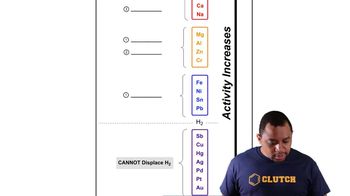
Activity Series Chart
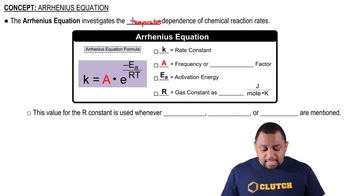
Arrhenius Equation
The Arrhenius equation relates the rate constant of a reaction to its activation energy and temperature. It is expressed as k = A * e^(-Ea/RT), where k is the rate constant, A is the frequency factor, Ea is the activation energy, R is the universal gas constant, and T is the temperature in Kelvin. This equation highlights how temperature and energy barriers influence reaction rates.
추천 영상:
가이드 코스
Arrhenius Equation
Rate Constant
The rate constant (k) is a proportionality factor in the rate law of a chemical reaction, indicating the speed at which the reaction occurs. It is influenced by factors such as temperature and activation energy. A higher rate constant signifies a faster reaction, while a lower rate constant indicates a slower reaction, making it a crucial parameter in chemical kinetics.
추천 영상:
가이드 코스
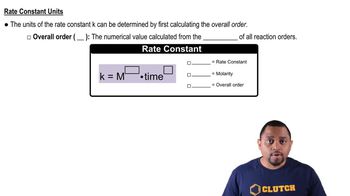
Rate Constant Units
관련 실천
교과서 질문
1360
views
교과서 질문
The diagram shows the energy of a reaction as the reaction progresses. Label each blank box in the diagram.
a. reactants b. products c. activation energy (Ea) d. enthalpy of reaction (ΔHrxn)
2043
views
교과서 질문
The half-life for the radioactive decay of C-14 is 5730 years and is independent of the initial concentration. If a sample of C-14 initially contains 1.5 mmol of C-14, how many millimoles are left after 2255 years?
1764
views
교과서 질문
The rate constant (k) for a reaction was measured as a function of temperature. A plot of ln k versus 1/T (in K) is linear and has a slope of -7445 K. Calculate the activation energy for the reaction.
6617
views
1
rank