Ch.14 - Chemical Kinetics
Tro - Chemistry: A Molecular Approach 4th Edition
Tro4th EditionChemistry: A Molecular ApproachISBN: 9780134112831당신이 사용하는 게 아니라요?교과서 변경
14장, 문제 63

The rate constant (k) for a reaction was measured as a function of temperature. A plot of ln k versus 1/T (in K) is linear and has a slope of -7445 K. Calculate the activation energy for the reaction.

검증된 단계별 안내
1
Identify the relationship between the slope of the plot and the activation energy using the Arrhenius equation: \( \ln k = \ln A - \frac{E_a}{R} \cdot \frac{1}{T} \).
Recognize that the slope of the plot \( \ln k \) versus \( \frac{1}{T} \) is equal to \( -\frac{E_a}{R} \), where \( E_a \) is the activation energy and \( R \) is the universal gas constant.
Use the given slope of the plot, which is -7445 K, and set it equal to \( -\frac{E_a}{R} \).
Solve for the activation energy \( E_a \) by rearranging the equation: \( E_a = -\text{slope} \times R \).
Substitute the value of the universal gas constant \( R = 8.314 \text{ J/mol K} \) into the equation to find \( E_a \).

비슷한 문제에 대한 검증된 영상 답변:

이 영상 해법은 위 문제에 도움이 된다고 튜터들이 추천한 것입니다.
도움이 되었나요?

주요 개념

질문에 올바르게 답하기 위해 반드시 이해해야 하는 핵심 개념들은 다음과 같습니다.

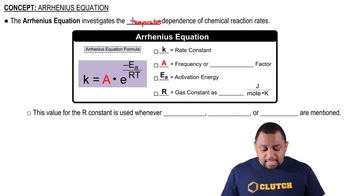
Arrhenius Equation

The Arrhenius equation relates the rate constant (k) of a chemical reaction to the temperature (T) and activation energy (Ea). It is expressed as k = A * e^(-Ea/RT), where A is the pre-exponential factor, R is the universal gas constant, and T is the temperature in Kelvin. This equation shows that as temperature increases, the rate constant typically increases, indicating a faster reaction.
추천 영상:
가이드 코스
01:20
Arrhenius Equation

Activation Energy (Ea)

Activation energy is the minimum energy required for a chemical reaction to occur. It represents the energy barrier that reactants must overcome to form products. A higher activation energy means that fewer molecules have sufficient energy to react at a given temperature, resulting in a slower reaction rate. It can be determined from the slope of a plot of ln k versus 1/T.
추천 영상:
가이드 코스
02:02
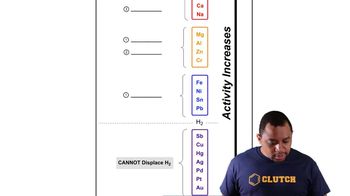
Activity Series Chart

Linear Relationship in ln k vs. 1/T

The linear relationship between ln k and 1/T indicates that the reaction follows the Arrhenius behavior. The slope of this line is equal to -Ea/R, where R is the gas constant. This linearity allows for the calculation of activation energy by rearranging the equation to Ea = -slope * R. In this case, the slope of -7445 K can be used to find the activation energy for the reaction.
추천 영상:
가이드 코스
02:43
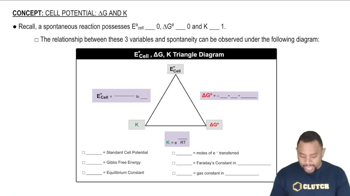
Relationship between ∆E°, ∆G°, and K