A reaction has a rate constant of 0.000122/s at 27 °C and 0.228/s at 77 °C. b. What is the value of the rate constant at 17 °C?
Ch.14 - Chemical Kinetics
14장, 문제 68
The tabulated data show the rate constant of a reaction measured at several different temperatures. Use an Arrhenius plot to determine the activation barrier and frequency factor for the reaction.
Temperature (K) Rate Constant (1 , s)
310 0.00434
320 0.0140
330 0.0421
340 0.118
350 0.316
검증된 단계별 안내1
Convert the temperature from Kelvin to the reciprocal of temperature in Kelvin (1/T) for each data point.
Take the natural logarithm of the rate constant (k) for each temperature.
Plot ln(k) on the y-axis against 1/T on the x-axis to create the Arrhenius plot.
Determine the slope of the line from the plot, which is equal to -Ea/R, where Ea is the activation energy and R is the gas constant (8.314 J/mol·K).
Calculate the activation energy (Ea) using the slope, and determine the frequency factor (A) by finding the y-intercept of the line, which is equal to ln(A).

비슷한 문제에 대한 검증된 영상 답변:
이 영상 해법은 위 문제에 도움이 된다고 튜터들이 추천한 것입니다.
영상 길이:
3m도움이 되었나요?
주요 개념
질문에 올바르게 답하기 위해 반드시 이해해야 하는 핵심 개념들은 다음과 같습니다.
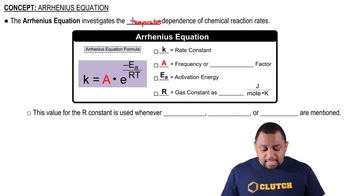
Arrhenius Equation
The Arrhenius equation describes how the rate constant of a chemical reaction depends on temperature and activation energy. It is expressed as k = A * e^(-Ea/RT), where k is the rate constant, A is the frequency factor, Ea is the activation energy, R is the universal gas constant, and T is the temperature in Kelvin. This relationship highlights the exponential increase in reaction rates with temperature, making it essential for analyzing reaction kinetics.
추천 영상:
가이드 코스
Arrhenius Equation
Activation Energy (Ea)
Activation energy is the minimum energy required for a chemical reaction to occur. It represents the energy barrier that reactants must overcome to transform into products. In an Arrhenius plot, which is a graph of ln(k) versus 1/T, the slope of the line is related to -Ea/R, allowing for the determination of the activation energy from experimental data.
추천 영상:
가이드 코스
Activity Series Chart
Frequency Factor (A)
The frequency factor, also known as the pre-exponential factor, is a constant in the Arrhenius equation that reflects the frequency of collisions and the orientation of reactants during a reaction. It is indicative of how often reactants collide with the correct orientation to react. The frequency factor can be determined alongside the activation energy when analyzing the slope and intercept of the Arrhenius plot.
추천 영상:
가이드 코스
Frequency-Wavelength Relationship
관련 실천
교과서 질문
2142
views
교과서 질문
A reaction has a rate constant of 0.0117/s at 400.0 K and 0.689/s at 450.0 K. a. Determine the activation barrier for the reaction.
2476
views
8
rank
교과서 질문
The data shown here were collected for the first-order reaction: N2O(g) → N2(g) + O(g) Use an Arrhenius plot to determine the activation barrier and frequency factor for the reaction.
Temperature (K) Rate Constant (1 , s)
800 3.24⨉10- 5
900 0.00214
1000 0.0614
1100 0.955
1575
views
교과서 질문
The tabulated data show the rate constant of a reaction measured at several different temperatures. Use an Arrhenius plot to determine the activation barrier and frequency factor for the reaction.
Temperature (K) Rate Constant (1 , s)
300 0.0134
310 0.0407
320 0.114
330 0.303
340 0.757
2534
views