
Ch.14 - Chemical Kinetics
Tro - Chemistry: A Molecular Approach 4th Edition
Tro4th EditionChemistry: A Molecular ApproachISBN: 9780134112831당신이 사용하는 게 아니라요?교과서 변경
14장, 문제 66

The tabulated data show the rate constant of a reaction measured at several different temperatures. Use an Arrhenius plot to determine the activation barrier and frequency factor for the reaction.
Temperature (K) Rate Constant (1 , s)
300 0.0134
310 0.0407
320 0.114
330 0.303
340 0.757

검증된 단계별 안내
1
insert step 1> Convert the given temperatures from Kelvin to the reciprocal of temperature in Kelvin (1/T) for each data point. This will be used for the x-axis of the Arrhenius plot.
insert step 2> Take the natural logarithm of each rate constant (k) to obtain ln(k) for each data point. This will be used for the y-axis of the Arrhenius plot.
insert step 3> Plot ln(k) versus 1/T. The resulting graph should be a straight line if the reaction follows the Arrhenius equation.
insert step 4> Determine the slope of the line from the plot. The slope is equal to -Ea/R, where Ea is the activation energy and R is the universal gas constant (8.314 J/mol·K).
insert step 5> Calculate the activation energy (Ea) using the slope from the plot. Then, use the y-intercept of the line to find the frequency factor (A) by rearranging the Arrhenius equation: ln(A) = y-intercept.

비슷한 문제에 대한 검증된 영상 답변:

이 영상 해법은 위 문제에 도움이 된다고 튜터들이 추천한 것입니다.
영상 길이:
3m
도움이 되었나요?

주요 개념

질문에 올바르게 답하기 위해 반드시 이해해야 하는 핵심 개념들은 다음과 같습니다.

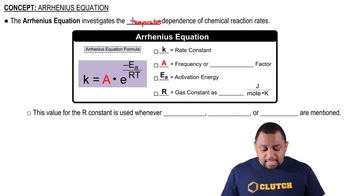
Arrhenius Equation

The Arrhenius equation relates the rate constant of a chemical reaction to temperature and activation energy. It is expressed as k = A * e^(-Ea/RT), where k is the rate constant, A is the frequency factor, Ea is the activation energy, R is the universal gas constant, and T is the temperature in Kelvin. This equation highlights how temperature influences reaction rates and allows for the determination of activation energy from experimental data.
추천 영상:
가이드 코스
01:20
Arrhenius Equation

Activation Energy (Ea)

Activation energy is the minimum energy required for a chemical reaction to occur. It represents the energy barrier that reactants must overcome to transform into products. In the context of the Arrhenius plot, the slope of the linear relationship between the natural logarithm of the rate constant and the inverse of temperature can be used to calculate the activation energy, providing insight into the reaction's kinetics.
추천 영상:
가이드 코스
02:02
Activity Series Chart

Frequency Factor (A)

The frequency factor, also known as the pre-exponential factor, is a constant in the Arrhenius equation that reflects the frequency of collisions and the orientation of reactants during a reaction. It indicates how often reactants collide with the correct orientation to form products. The frequency factor is crucial for understanding the overall rate of a reaction, especially when combined with the activation energy to predict how changes in temperature affect reaction rates.
추천 영상:
가이드 코스
00:31
Frequency-Wavelength Relationship