Ch.17 - Aqueous Ionic Equilibrium
Tro - Chemistry: A Molecular Approach 4th Edition
Tro4th EditionChemistry: A Molecular ApproachISBN: 9780134112831당신이 사용하는 게 아니라요?교과서 변경
17장, 문제 74d

A 25.0-mL sample of 0.125 M pyridine is titrated with 0.100 M HCl. Calculate the pH at each volume of added acid: equivalence point.

검증된 단계별 안내
1
Identify the reaction: Pyridine (C_5H_5N) is a weak base and reacts with HCl, a strong acid, to form pyridinium chloride (C_5H_5NH^+Cl^-).
Calculate the moles of pyridine initially present using the formula: \( \text{moles} = \text{concentration} \times \text{volume} \).
Determine the volume of HCl needed to reach the equivalence point by using the stoichiometry of the reaction, where moles of HCl equal moles of pyridine.
At the equivalence point, all pyridine is converted to pyridinium ion (C_5H_5NH^+). Calculate the concentration of C_5H_5NH^+ in the solution.
Use the hydrolysis of the pyridinium ion to find the pH. Set up the equilibrium expression for the reaction of C_5H_5NH^+ with water and solve for \([H^+]\) to find the pH.

비슷한 문제에 대한 검증된 영상 답변:

이 영상 해법은 위 문제에 도움이 된다고 튜터들이 추천한 것입니다.
영상 길이:
10m

주요 개념

질문에 올바르게 답하기 위해 반드시 이해해야 하는 핵심 개념들은 다음과 같습니다.

Titration

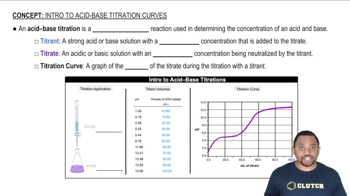
Titration is a quantitative analytical technique used to determine the concentration of a solute in a solution. It involves the gradual addition of a titrant (in this case, HCl) to a solution of the analyte (pyridine) until the reaction reaches its equivalence point, where stoichiometrically equivalent amounts of acid and base have reacted.
추천 영상:
가이드 코스
03:04
Acid-Base Titration

Equivalence Point

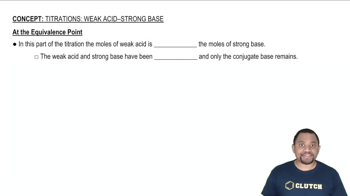
The equivalence point in a titration is the stage at which the amount of titrant added is exactly enough to completely neutralize the analyte in the solution. At this point, the moles of acid equal the moles of base, resulting in a solution that may contain the salt formed from the reaction, and the pH can be determined based on the properties of the resulting solution.
추천 영상:
가이드 코스
01:07
At the Equivalence Point

pH Calculation

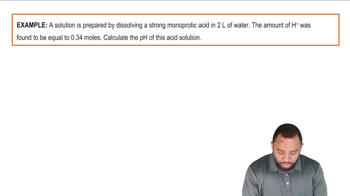
pH is a measure of the acidity or basicity of a solution, defined as the negative logarithm of the hydrogen ion concentration. At the equivalence point of a titration involving a weak base (like pyridine) and a strong acid (like HCl), the pH can be calculated using the concentration of the resulting salt and its hydrolysis in water, which affects the final pH of the solution.
추천 영상:
가이드 코스
02:15
pH Calculation Example