Ch.17 - Aqueous Ionic Equilibrium
Tro - Chemistry: A Molecular Approach 4th Edition
Tro4th EditionChemistry: A Molecular ApproachISBN: 9780134112831당신이 사용하는 게 아니라요?교과서 변경
17장, 문제 74e

A 25.0-mL sample of 0.125 M pyridine is titrated with 0.100 M HCl. Calculate the pH at each volume of added acid: one-half equivalence.

검증된 단계별 안내
1
Identify the equivalence point by calculating the volume of HCl needed to completely neutralize the pyridine. Use the formula: \( V_{eq} = \frac{C_{base} \times V_{base}}{C_{acid}} \), where \( C_{base} \) and \( V_{base} \) are the concentration and volume of the pyridine, and \( C_{acid} \) is the concentration of HCl.
Calculate the volume of HCl needed to reach one-half equivalence point, which is half of the volume calculated in step 1.
Determine the moles of pyridine initially present using the formula: \( n_{pyridine} = C_{base} \times V_{base} \).
Calculate the moles of HCl added at one-half equivalence point using the formula: \( n_{HCl} = C_{acid} \times V_{HCl} \), where \( V_{HCl} \) is the volume of HCl at one-half equivalence point.
Use the Henderson-Hasselbalch equation to calculate the pH: \( pH = pKa + \log\left(\frac{\text{moles of base remaining}}{\text{moles of acid added}}\right) \). Note that the pKa of pyridine is approximately 5.23.

비슷한 문제에 대한 검증된 영상 답변:

이 영상 해법은 위 문제에 도움이 된다고 튜터들이 추천한 것입니다.
영상 길이:
2m

주요 개념

질문에 올바르게 답하기 위해 반드시 이해해야 하는 핵심 개념들은 다음과 같습니다.

Titration

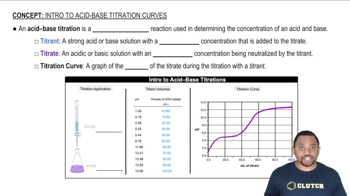
Titration is a quantitative analytical technique used to determine the concentration of a solute in a solution. It involves the gradual addition of a titrant (in this case, HCl) to a solution of the analyte (pyridine) until the reaction reaches its equivalence point. The volume of titrant used at this point allows for the calculation of the analyte's concentration.
추천 영상:
가이드 코스
03:04
Acid-Base Titration

Equivalence Point and Half-Equivalence Point

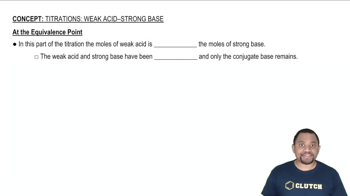
The equivalence point in a titration is reached when the amount of titrant added is stoichiometrically equivalent to the amount of analyte present. The half-equivalence point occurs when half of the analyte has reacted, which is significant for weak acid-strong base titrations as it allows for the calculation of pH using the Henderson-Hasselbalch equation, reflecting the balance between the weak base and its conjugate acid.
추천 영상:
가이드 코스
01:07
At the Equivalence Point

Henderson-Hasselbalch Equation

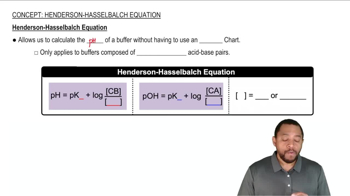
The Henderson-Hasselbalch equation is a formula used to calculate the pH of a buffer solution. It relates the pH to the pKa of the acid and the ratio of the concentrations of the conjugate base and the acid. In the context of the titration of pyridine with HCl, this equation is essential for determining the pH at the half-equivalence point, where the concentrations of pyridine and pyridinium ion are equal.
추천 영상:
가이드 코스
02:40
Henderson-Hasselbalch Equation