A 25.0-mL sample of 0.125 M pyridine is titrated with 0.100 M HCl. Calculate the pH at each volume of added acid: one-half equivalence.
Ch.17 - Aqueous Ionic Equilibrium
17장, 문제 74b
A 25.0-mL sample of 0.125 M pyridine is titrated with 0.100 M HCl. Calculate the pH at each volume of added acid: 10 mL.
검증된 단계별 안내1
Identify the initial moles of pyridine (C5H5N) in the solution using the formula: \( \text{moles} = \text{concentration} \times \text{volume} \).
Calculate the moles of HCl added using the formula: \( \text{moles} = \text{concentration} \times \text{volume} \).
Determine the reaction between pyridine (a weak base) and HCl (a strong acid), which forms pyridinium ion (C5H5NH^+). The reaction is: \( \text{C5H5N} + \text{HCl} \rightarrow \text{C5H5NH}^+ + \text{Cl}^- \).
Calculate the moles of pyridine and pyridinium ion after the reaction to find the remaining moles of pyridine and the moles of pyridinium ion formed.
Use the Henderson-Hasselbalch equation to calculate the pH: \( \text{pH} = \text{pK}_a + \log \left( \frac{[\text{base}]}{[\text{acid}]} \right) \), where \( \text{pK}_a \) is derived from the \( \text{K}_b \) of pyridine.

비슷한 문제에 대한 검증된 영상 답변:
이 영상 해법은 위 문제에 도움이 된다고 튜터들이 추천한 것입니다.
영상 길이:
5m주요 개념
질문에 올바르게 답하기 위해 반드시 이해해야 하는 핵심 개념들은 다음과 같습니다.
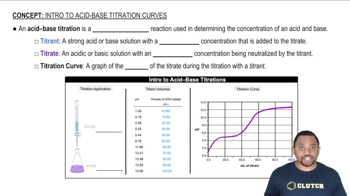
Acid-Base Titration
An acid-base titration is a quantitative analytical method used to determine the concentration of an acid or base in a solution. In this process, a solution of known concentration (the titrant) is added to a solution of unknown concentration until the reaction reaches its equivalence point, where the amount of acid equals the amount of base. The pH changes during the titration, and understanding this change is crucial for calculating the pH at specific volumes of titrant added.
추천 영상:
가이드 코스
Acid-Base Titration
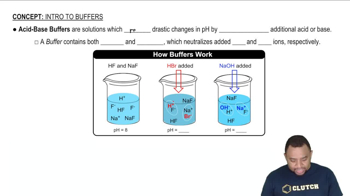
Buffer Solutions
Buffer solutions are mixtures that can resist changes in pH upon the addition of small amounts of acid or base. In this case, pyridine acts as a weak base and can form a buffer with its conjugate acid, pyridinium ion, when titrated with HCl. The presence of a buffer system is essential for understanding the pH changes during the titration, especially before reaching the equivalence point, where the solution can maintain a relatively stable pH.
추천 영상:
가이드 코스
Buffer Solutions
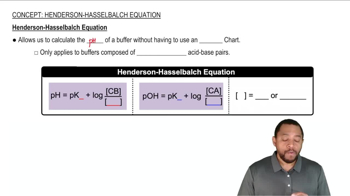
Henderson-Hasselbalch Equation
The Henderson-Hasselbalch equation is a mathematical formula used to calculate the pH of a buffer solution. It relates the pH of the solution to the pKa of the weak acid and the ratio of the concentrations of the conjugate base and the weak acid. This equation is particularly useful in titration problems involving weak acids and bases, as it allows for the determination of pH at various points in the titration process, including before and after the addition of titrant.
추천 영상:
가이드 코스
Henderson-Hasselbalch Equation
관련 실천
교과서 질문
453
views
교과서 질문
Consider the titration of a 25.0-mL sample of 0.175 M CH3NH2 with 0.150 M HBr. Determine each quantity. e. the pH at the equivalence point
588
views
교과서 질문
A 25.0-mL sample of 0.125 M pyridine is titrated with 0.100 M HCl. Calculate the pH at each volume of added acid: equivalence point.
1863
views
교과서 질문
Consider the titration of a 25.0-mL sample of 0.175 M CH3NH2 with 0.150 M HBr. Determine each quantity. c. the pH at 5.0 mL of added acid
3117
views
교과서 질문
A 25.0-mL sample of 0.125 M pyridine is titrated with 0.100 M HCl. Calculate the pH at each volume of added acid: 0 mL.
330
views
교과서 질문
A 25.0-mL sample of 0.125 M pyridine is titrated with 0.100 M HCl. Calculate the pH at each volume of added acid: 20 mL.
356
views