Ch.18 - Free Energy and Thermodynamics
Tro - Chemistry: A Molecular Approach 4th Edition
Tro4th EditionChemistry: A Molecular ApproachISBN: 9780134112831당신이 사용하는 게 아니라요?교과서 변경
18장, 문제 31

Calculate the change in entropy that occurs in the system when 1.00 mole of isopropyl alcohol (C3H8O) melts at its melting point (-89.5 °C). See Table 11.9 for heats of fusion.

검증된 단계별 안내
1
Identify the formula for calculating the change in entropy (\( \Delta S \)) during a phase change: \( \Delta S = \frac{q_{\text{rev}}}{T} \), where \( q_{\text{rev}} \) is the heat absorbed or released during the process and \( T \) is the temperature in Kelvin.
Determine the heat of fusion (\( \Delta H_{\text{fus}} \)) for isopropyl alcohol from Table 11.9. This value represents the amount of heat required to melt one mole of the substance at its melting point.
Convert the melting point from Celsius to Kelvin by adding 273.15 to the given temperature: \( T = -89.5 + 273.15 \).
Substitute the values into the entropy change formula: \( \Delta S = \frac{\Delta H_{\text{fus}}}{T} \). Ensure that \( \Delta H_{\text{fus}} \) is in joules if it is initially given in kilojoules.
Calculate \( \Delta S \) using the values obtained in the previous steps to find the change in entropy for the melting of 1.00 mole of isopropyl alcohol.

비슷한 문제에 대한 검증된 영상 답변:

이 영상 해법은 위 문제에 도움이 된다고 튜터들이 추천한 것입니다.
영상 길이:
1m

주요 개념

질문에 올바르게 답하기 위해 반드시 이해해야 하는 핵심 개념들은 다음과 같습니다.

Entropy

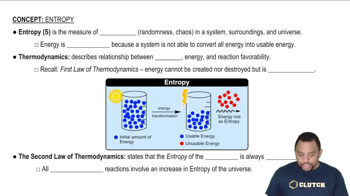
Entropy is a measure of the disorder or randomness in a system. In thermodynamics, it quantifies the number of ways a system can be arranged, with higher entropy indicating greater disorder. When a substance changes state, such as melting, the entropy typically increases because the molecules have more freedom to move in the liquid state compared to the solid state.
추천 영상:
가이드 코스
02:46
Entropy in Thermodynamics

Heats of Fusion

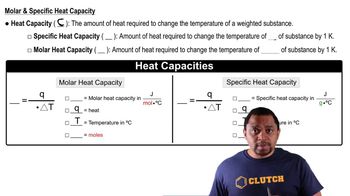
The heat of fusion is the amount of energy required to change a substance from solid to liquid at its melting point without changing its temperature. This value is crucial for calculating the change in entropy during phase transitions, as it provides the necessary energy input for the melting process. It is typically expressed in joules per mole (J/mol).
추천 영상:

Gibbs Free Energy and Phase Changes

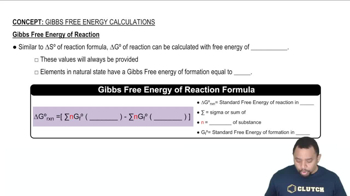
Gibbs free energy is a thermodynamic potential that helps predict the direction of chemical reactions and phase changes. At equilibrium, the change in Gibbs free energy (ΔG) is zero, and the relationship between entropy (ΔS) and enthalpy (ΔH) is given by the equation ΔG = ΔH - TΔS. Understanding this relationship is essential for calculating changes in entropy during phase transitions like melting.
추천 영상:
가이드 코스
01:51
Gibbs Free Energy of Reactions