Consider the reaction: I2(g) + Cl2(g) ⇌ 2 ICl(g) Kp = 81.9 at 25 °C Calculate ΔGrxn for the reaction at 25 °C under each of the following conditions: a. standard conditions
Ch.18 - Free Energy and Thermodynamics
18장, 문제 74
Use data from Appendix IIB to calculate the equilibrium constants at 25 °C for each reaction. ΔG°f for BrCl(g) is -1.0 kJ/mol. a. 2 NO2(g) ⇌ N2O4(g) b. Br2(g) + Cl2(g) ⇌ 2 BrCl(g)
검증된 단계별 안내1
Identify the relationship between the standard Gibbs free energy change (\( \Delta G^\circ \)) and the equilibrium constant (\( K \)) using the equation: \( \Delta G^\circ = -RT \ln K \), where \( R \) is the gas constant (8.314 J/mol·K) and \( T \) is the temperature in Kelvin.
Convert the temperature from Celsius to Kelvin by adding 273.15 to the given temperature (25 °C).
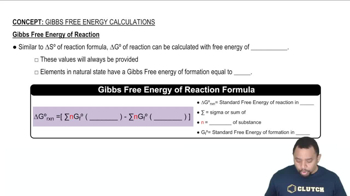
For reaction (a), use Appendix IIB to find the \( \Delta G^\circ_f \) values for \( \text{NO}_2(g) \) and \( \text{N}_2\text{O}_4(g) \). Calculate \( \Delta G^\circ \) for the reaction using the formula: \( \Delta G^\circ = \sum \Delta G^\circ_f(\text{products}) - \sum \Delta G^\circ_f(\text{reactants}) \).
For reaction (b), use the given \( \Delta G^\circ_f \) for \( \text{BrCl(g)} \) and find \( \Delta G^\circ_f \) values for \( \text{Br}_2(g) \) and \( \text{Cl}_2(g) \) from Appendix IIB. Calculate \( \Delta G^\circ \) for the reaction using the same formula as in step 3.
Solve for the equilibrium constant \( K \) for each reaction by rearranging the equation from step 1 to \( K = e^{-\Delta G^\circ / RT} \) and substituting the calculated \( \Delta G^\circ \) values.
주요 개념
질문에 올바르게 답하기 위해 반드시 이해해야 하는 핵심 개념들은 다음과 같습니다.
Gibbs Free Energy and Equilibrium
Gibbs Free Energy (ΔG) is a thermodynamic potential that helps predict the direction of chemical reactions. At equilibrium, ΔG is zero, indicating that the forward and reverse reactions occur at the same rate. The relationship between ΔG and the equilibrium constant (K) is given by the equation ΔG° = -RT ln(K), where R is the gas constant and T is the temperature in Kelvin.
추천 영상:
가이드 코스
Gibbs Free Energy of Reactions
Equilibrium Constant (K)
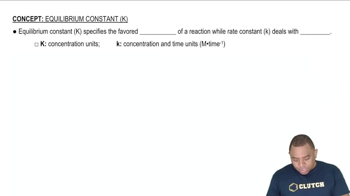
The equilibrium constant (K) quantifies the ratio of the concentrations of products to reactants at equilibrium for a given reaction. It is temperature-dependent and can be calculated using the formula K = [products]^[coefficients] / [reactants]^[coefficients]. A larger K value indicates a greater concentration of products at equilibrium, while a smaller K suggests a preference for reactants.
추천 영상:
가이드 코스
Equilibrium Constant K
Standard Gibbs Free Energy of Formation (ΔG°f)
The standard Gibbs Free Energy of formation (ΔG°f) is the change in Gibbs Free Energy when one mole of a compound is formed from its elements in their standard states. It is a crucial value for calculating the ΔG of a reaction and, consequently, the equilibrium constant. In this question, the ΔG°f for BrCl(g) is provided, which will be used to determine the equilibrium constant for the reaction involving Br2 and Cl2.
추천 영상:
가이드 코스
Standard Gibbs Free Energy and Temperature
관련 실천
교과서 질문
811
views
교과서 질문
Consider the reaction: CO2(g) + CCl4(g) ⇌ 2 COCl2(g) Calculate ΔG for this reaction at 25 °C under the following conditions: i. PCO2 = 0.112 atm ii. PCCl4 = 0.174 atm iii. PCOCl2 = 0.744 atm
2712
views
1
comments
교과서 질문
Use data from Appendix IIB to calculate the equilibrium constants at 25 °C for each reaction. a. 2 CO(g) + O2(g) ⇌ 2 CO2(g)
2420
views
1
rank
교과서 질문
Use data from Appendix IIB to calculate the equilibrium constants at 25 °C for each reaction. b. 2 H2S(g) ⇌ 2 H2(g) + S2(g)
551
views
교과서 질문
Consider the reaction: I2(g) + Cl2(g) ⇌ 2 ICl(g) Kp = 81.9 at 25 °C Calculate ΔGrxn for the reaction at 25 °C under each of the following conditions: b. at equilibrium
977
views