Ch.20 - Radioactivity and Nuclear Chemistry
Tro - Chemistry: A Molecular Approach 4th Edition
Tro4th EditionChemistry: A Molecular ApproachISBN: 9780134112831당신이 사용하는 게 아니라요?교과서 변경
20장, 문제 37

Determine whether or not each nuclide is likely to be stable. State your reasons. a. Mg-26 b. Ne-25 c. Co-51

검증된 단계별 안내
1
Identify the atomic number and mass number of the nuclide. For Co-51, cobalt (Co) has an atomic number of 27, and the mass number is 51.
Calculate the number of neutrons by subtracting the atomic number from the mass number: Neutrons = Mass number - Atomic number = 51 - 27.
Check the neutron-to-proton (n/p) ratio. A stable n/p ratio is typically around 1 for lighter elements and increases slightly for heavier elements.
Compare the n/p ratio of Co-51 to the known stable isotopes of cobalt. The most stable isotope of cobalt is Co-59, which has a different n/p ratio.
Consider the position of Co-51 on the chart of nuclides. Nuclides far from the line of stability are usually unstable and may undergo radioactive decay.

비슷한 문제에 대한 검증된 영상 답변:

이 영상 해법은 위 문제에 도움이 된다고 튜터들이 추천한 것입니다.
영상 길이:
1m
도움이 되었나요?

주요 개념

질문에 올바르게 답하기 위해 반드시 이해해야 하는 핵심 개념들은 다음과 같습니다.

Nuclear Stability

Nuclear stability refers to the ability of a nucleus to remain intact without undergoing radioactive decay. Stable nuclides have a balanced ratio of protons to neutrons, which helps to counteract the repulsive forces between protons. Generally, nuclides with a neutron-to-proton ratio close to 1:1 are more likely to be stable, while those with extreme ratios tend to be unstable and radioactive.
추천 영상:
가이드 코스
03:29
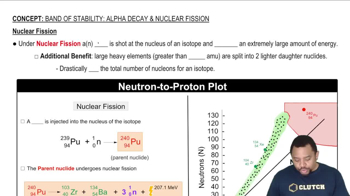
Band of Stability: Nuclear Fission

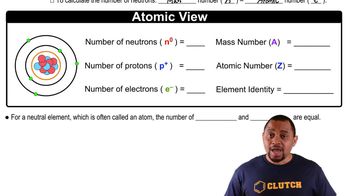
Isotopes and Their Stability

Isotopes are variants of a chemical element that have the same number of protons but different numbers of neutrons. The stability of an isotope can vary significantly; for example, some isotopes are stable while others are radioactive and decay over time. Understanding the specific isotopes of an element, such as Co-51, is crucial for predicting their stability and behavior in nuclear reactions.
추천 영상:

Magic Numbers in Nuclear Physics

Magic numbers are specific numbers of nucleons (protons or neutrons) that result in particularly stable configurations of the nucleus. These numbers correspond to complete shells of nucleons, leading to enhanced stability. For example, nuclei with 2, 8, 20, 28, 50, 82, or 126 nucleons are often more stable, while those that do not align with these magic numbers may be more prone to instability and decay.
추천 영상:
가이드 코스
02:06
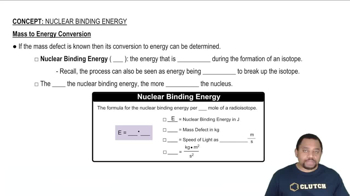
Nuclear Binding Energy