Ch.20 - Radioactivity and Nuclear Chemistry
Tro - Chemistry: A Molecular Approach 4th Edition
Tro4th EditionChemistry: A Molecular ApproachISBN: 9780134112831당신이 사용하는 게 아니라요?교과서 변경
20장, 문제 38

Determine whether or not each nuclide is likely to be stable. State your reasons. a. Ti-48 b. Cr-63 c. Sn-102 d. Y-88

검증된 단계별 안내
1
To determine the stability of a nuclide, consider the neutron-to-proton (N/Z) ratio. A stable nuclide typically has an N/Z ratio close to 1 for lighter elements and slightly higher for heavier elements.
For Ti-48: Titanium (Ti) has an atomic number of 22, meaning it has 22 protons. Ti-48 has 48 - 22 = 26 neutrons. Calculate the N/Z ratio: \( \frac{26}{22} \). Compare this ratio to the typical stable range for elements around titanium.
For Cr-63: Chromium (Cr) has an atomic number of 24, meaning it has 24 protons. Cr-63 has 63 - 24 = 39 neutrons. Calculate the N/Z ratio: \( \frac{39}{24} \). Check if this ratio falls within the stable range for elements around chromium.
For Sn-102: Tin (Sn) has an atomic number of 50, meaning it has 50 protons. Sn-102 has 102 - 50 = 52 neutrons. Calculate the N/Z ratio: \( \frac{52}{50} \). Determine if this ratio is typical for stable isotopes of tin.
For Y-88: Yttrium (Y) has an atomic number of 39, meaning it has 39 protons. Y-88 has 88 - 39 = 49 neutrons. Calculate the N/Z ratio: \( \frac{49}{39} \). Evaluate if this ratio is within the stable range for yttrium isotopes.

비슷한 문제에 대한 검증된 영상 답변:

이 영상 해법은 위 문제에 도움이 된다고 튜터들이 추천한 것입니다.
영상 길이:
1m
도움이 되었나요?

주요 개념

질문에 올바르게 답하기 위해 반드시 이해해야 하는 핵심 개념들은 다음과 같습니다.

Nuclear Stability

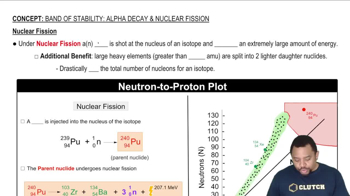
Nuclear stability refers to the ability of a nuclide to remain unchanged over time without undergoing radioactive decay. Stable nuclides have a balanced ratio of protons to neutrons, which minimizes the forces that can lead to instability. Understanding the stability of a nuclide is crucial for predicting its behavior and longevity.
추천 영상:
가이드 코스
03:29
Band of Stability: Nuclear Fission

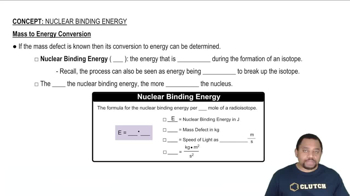
Nuclear Binding Energy

Nuclear binding energy is the energy required to disassemble a nucleus into its constituent protons and neutrons. A higher binding energy indicates a more stable nucleus, as it suggests that the nucleons are held together more tightly. This concept helps in assessing the stability of different isotopes based on their nuclear structure.
추천 영상:
가이드 코스
02:06
Nuclear Binding Energy

Magic Numbers

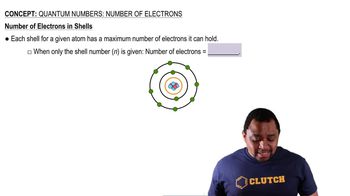
Magic numbers are specific numbers of nucleons (protons or neutrons) that result in particularly stable configurations within a nucleus. These numbers correspond to complete shells of nucleons, leading to enhanced stability. Recognizing magic numbers can aid in predicting the stability of isotopes, as nuclides with these numbers are often more stable.
추천 영상:
가이드 코스
00:46
Number of Electrons in Shells