Ch.20 - Radioactivity and Nuclear Chemistry
Tro - Chemistry: A Molecular Approach 4th Edition
Tro4th EditionChemistry: A Molecular ApproachISBN: 9780134112831당신이 사용하는 게 아니라요?교과서 변경
20장, 문제 37d

Determine whether or not each nuclide is likely to be stable. State your reasons. d. Te-124

검증된 단계별 안내
1
insert step 1> Determine the number of protons and neutrons in the nuclide. Tellurium (Te) has an atomic number of 52, which means it has 52 protons. The mass number of Te-124 is 124, so the number of neutrons is 124 - 52 = 72.
insert step 2> Check the neutron-to-proton (N/Z) ratio. For stability, lighter elements (Z < 20) typically have an N/Z ratio close to 1, while heavier elements have a ratio slightly greater than 1. Calculate the N/Z ratio for Te-124: N/Z = 72/52.
insert step 3> Compare the N/Z ratio to the expected range for stability. For elements with atomic numbers around 52, a stable N/Z ratio is typically between 1.2 and 1.5.
insert step 4> Consider the magic numbers. Magic numbers are specific numbers of nucleons (either protons or neutrons) that result in more stable configurations. Check if 52 (protons) or 72 (neutrons) is a magic number.
insert step 5> Evaluate the overall stability based on the N/Z ratio and magic numbers. If the N/Z ratio is within the stable range and/or if the nuclide has a magic number of protons or neutrons, it is more likely to be stable.

비슷한 문제에 대한 검증된 영상 답변:

이 영상 해법은 위 문제에 도움이 된다고 튜터들이 추천한 것입니다.
영상 길이:
1m
도움이 되었나요?

주요 개념

질문에 올바르게 답하기 위해 반드시 이해해야 하는 핵심 개념들은 다음과 같습니다.

Nuclear Stability

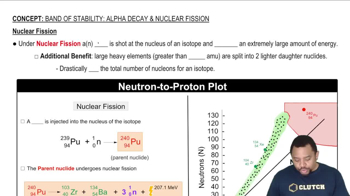
Nuclear stability refers to the ability of a nucleus to remain intact without undergoing radioactive decay. Stable nuclides have a balanced ratio of protons to neutrons, which helps to minimize repulsive forces between protons and provides sufficient strong nuclear force to hold the nucleus together.
추천 영상:
가이드 코스
03:29
Band of Stability: Nuclear Fission

Isotopes and Nuclides

Isotopes are variants of a chemical element that have the same number of protons but different numbers of neutrons. Each isotope is referred to as a nuclide, and the stability of a nuclide can vary significantly based on its neutron-to-proton ratio, influencing its likelihood of being stable or radioactive.
추천 영상:

Magic Numbers

Magic numbers are specific numbers of protons or neutrons in a nucleus that result in enhanced stability. These numbers (2, 8, 20, 28, 50, 82, and 126) correspond to completely filled nuclear shells, leading to a lower probability of decay. Understanding these can help predict the stability of isotopes like Te-124.
추천 영상:
가이드 코스
00:46
Number of Electrons in Shells