
Ch.5 - Gases
Tro - Chemistry: A Molecular Approach 4th Edition
Tro4th EditionChemistry: A Molecular ApproachISBN: 9780134112831당신이 사용하는 게 아니라요?교과서 변경
5장, 문제 115

A scuba diver creates a spherical bubble with a radius of 2.5 cm at a depth of 30.0 m where the total pressure (including atmospheric pressure) is 4.00 atm. What is the radius of the bubble when it reaches the surface of the water? (Assume that the atmospheric pressure is 1.00 atm and the temperature is 298 K.)

검증된 단계별 안내
1
Identify the initial and final conditions of the bubble. Initially, the bubble is at a depth of 30.0 m with a total pressure of 4.00 atm and a radius of 2.5 cm. At the surface, the pressure is 1.00 atm.
Apply the ideal gas law in the form of Boyle's Law, which states that for a given amount of gas at constant temperature, the product of pressure and volume is constant: \( P_1V_1 = P_2V_2 \).
Calculate the initial volume \( V_1 \) of the bubble using the formula for the volume of a sphere: \( V_1 = \frac{4}{3}\pi r_1^3 \), where \( r_1 = 2.5 \) cm.
Set up the equation using Boyle's Law: \( 4.00 \text{ atm} \times V_1 = 1.00 \text{ atm} \times V_2 \). Solve for \( V_2 \), the volume of the bubble at the surface.
Calculate the final radius \( r_2 \) of the bubble at the surface using the formula for the volume of a sphere: \( V_2 = \frac{4}{3}\pi r_2^3 \). Solve for \( r_2 \).

비슷한 문제에 대한 검증된 영상 답변:

이 영상 해법은 위 문제에 도움이 된다고 튜터들이 추천한 것입니다.
영상 길이:
2m
도움이 되었나요?

주요 개념

질문에 올바르게 답하기 위해 반드시 이해해야 하는 핵심 개념들은 다음과 같습니다.

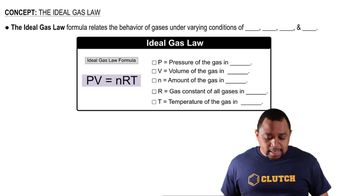
Ideal Gas Law

The Ideal Gas Law relates the pressure, volume, temperature, and number of moles of a gas through the equation PV = nRT. In this scenario, the pressure and volume of the gas bubble change as it ascends, while the temperature remains constant. Understanding this law is crucial for calculating how the volume (and thus the radius) of the bubble changes with pressure.
추천 영상:
가이드 코스
01:15
Ideal Gas Law Formula

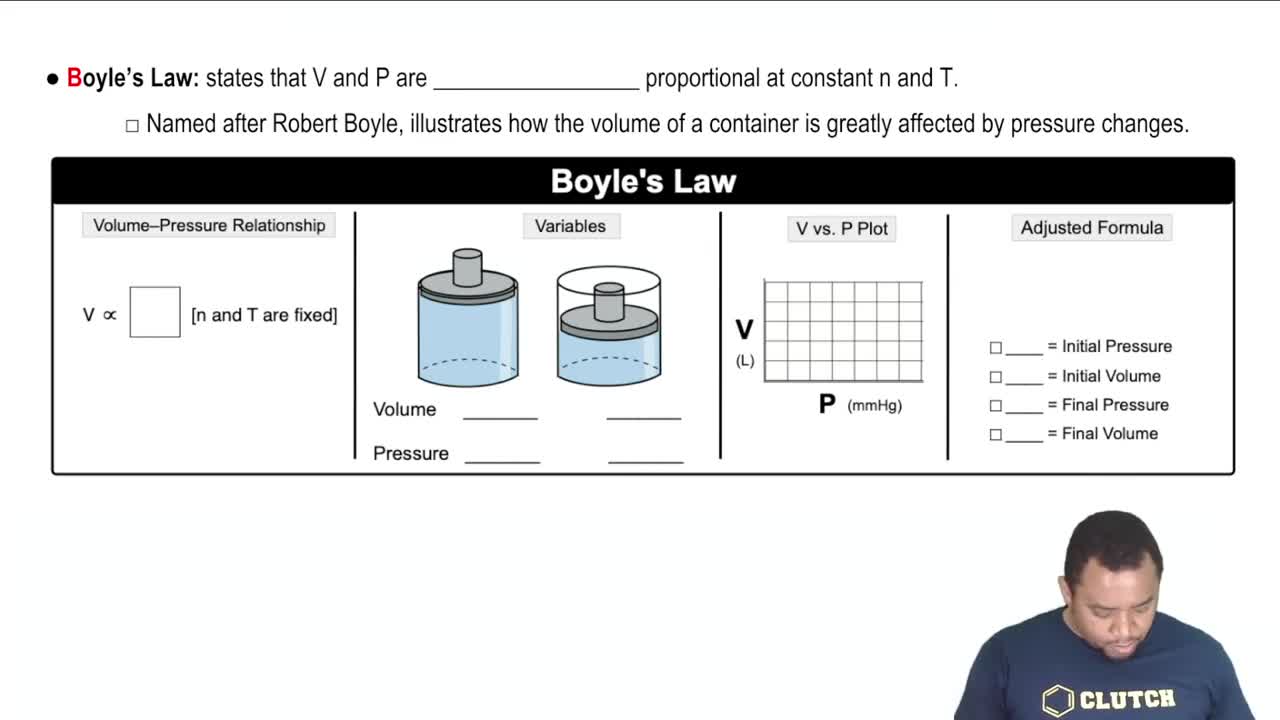
Boyle's Law

Boyle's Law states that the pressure of a gas is inversely proportional to its volume when temperature is held constant (P1V1 = P2V2). This principle is essential for determining how the volume of the bubble will change as the diver ascends and the pressure decreases from 4.00 atm to 1.00 atm, allowing us to find the new radius of the bubble at the surface.
추천 영상:

Spherical Geometry

The volume of a sphere is calculated using the formula V = (4/3)πr³, where r is the radius. When the volume of the bubble changes due to pressure changes, the radius can be derived from the new volume. Understanding spherical geometry is necessary to relate the volume of the bubble to its radius, which is the final step in solving the problem.
추천 영상:
가이드 코스
04:44
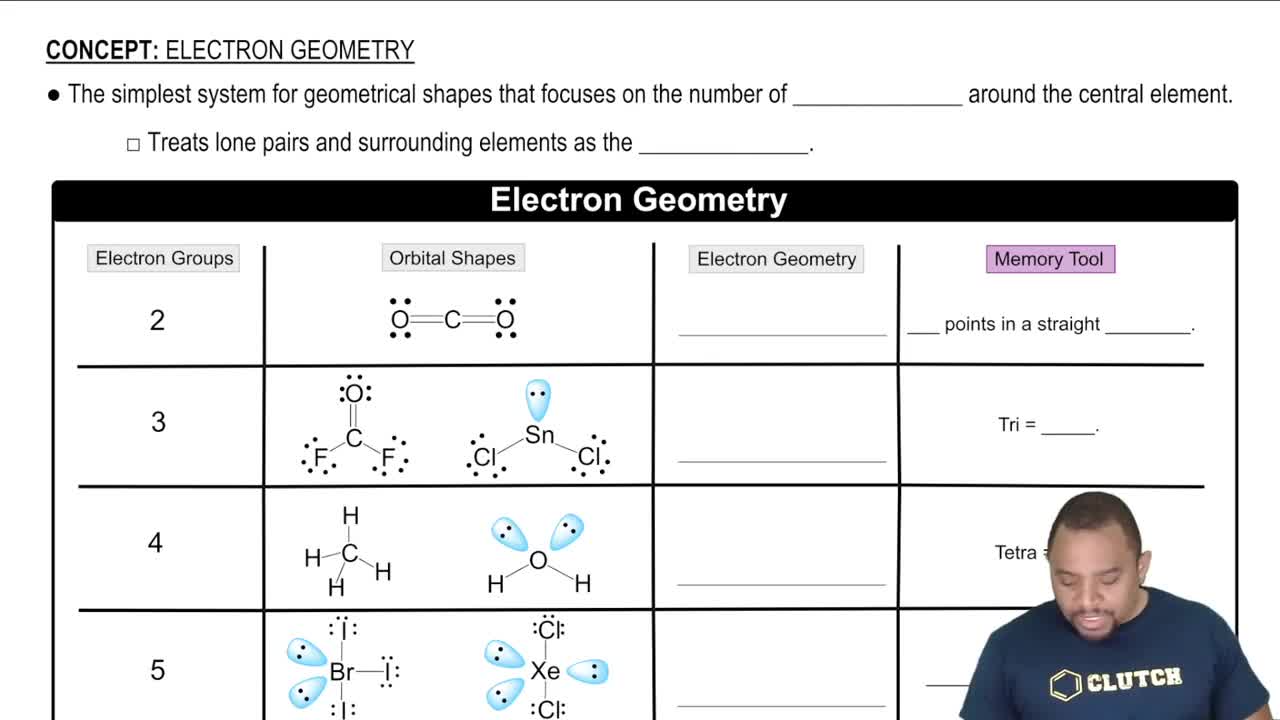
Electron Geometry