

Ch.5 - Gases
Tro - Chemistry: A Molecular Approach 4th Edition
Tro4th EditionChemistry: A Molecular ApproachISBN: 9780134112831당신이 사용하는 게 아니라요?교과서 변경
5장, 문제 117

A catalytic converter in an automobile uses a palladium or platinum catalyst (a substance that increases the rate of a reaction without being consumed by the reaction) to convert carbon monoxide gas to carbon dioxide according to the reaction: 2 CO(g) + O2(g) → 2 CO2(g) A chemist researching the effectiveness of a new catalyst combines a 2.0:1.0 mole ratio mixture of carbon monoxide and oxygen gas (respectively) over the catalyst in a 2.45-L flask at a total pressure of 745 torr and a temperature of 552 °C. When the reaction is complete, the pressure in the flask has dropped to 552 torr. What percentage of the carbon monoxide was converted to carbon dioxide?

검증된 단계별 안내
1
Convert the given temperature from Celsius to Kelvin by adding 273.15 to the Celsius temperature.
Use the ideal gas law, PV = nRT, to calculate the initial moles of gas in the flask. Remember to convert pressure from torr to atm by dividing by 760.
Determine the initial moles of CO and O2 using the given mole ratio (2.0:1.0) and the total initial moles calculated from the ideal gas law.
Calculate the change in moles of gas using the initial and final pressures, again using the ideal gas law to find the final moles of gas.
Use stoichiometry to determine the moles of CO converted to CO2, and then calculate the percentage of CO converted by comparing the moles of CO converted to the initial moles of CO.

비슷한 문제에 대한 검증된 영상 답변:

이 영상 해법은 위 문제에 도움이 된다고 튜터들이 추천한 것입니다.
도움이 되었나요?

주요 개념

질문에 올바르게 답하기 위해 반드시 이해해야 하는 핵심 개념들은 다음과 같습니다.

Stoichiometry

Stoichiometry is the calculation of reactants and products in chemical reactions based on the balanced chemical equation. It allows chemists to determine the proportions of substances involved in a reaction. In this case, the stoichiometric coefficients indicate that two moles of carbon monoxide react with one mole of oxygen to produce two moles of carbon dioxide, which is essential for calculating the conversion percentage.
추천 영상:
가이드 코스
01:16
Stoichiometry Concept

Gas Laws

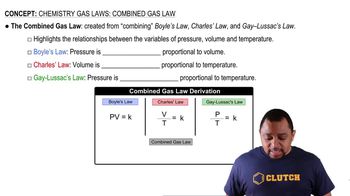
Gas laws describe the behavior of gases in relation to pressure, volume, and temperature. The ideal gas law (PV=nRT) is particularly useful for understanding how changes in these variables affect gas reactions. In this scenario, the initial and final pressures, along with the volume and temperature, can be used to determine the amount of gas present before and after the reaction, which is crucial for calculating the conversion of carbon monoxide.
추천 영상:
가이드 코스
01:43
Combined Gas Law

Catalysis

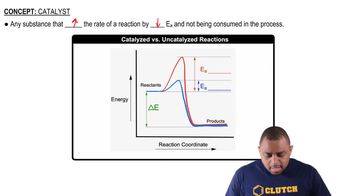
Catalysis refers to the process of increasing the rate of a chemical reaction by adding a substance called a catalyst, which is not consumed in the reaction. In the context of the catalytic converter, palladium or platinum facilitates the conversion of harmful gases like carbon monoxide into less harmful gases like carbon dioxide. Understanding how catalysts work helps in evaluating the efficiency of the reaction and the extent of conversion achieved.
추천 영상:
가이드 코스
01:59
Catalyzed vs. Uncatalyzed Reactions