Ch.20 - Electrochemistry
Tro - Chemistry: A Molecular Approach 6th Edition
Tro6th EditionChemistry: A Molecular ApproachISBN: 9780137832217당신이 사용하는 게 아니라요?교과서 변경
20장, 문제 71

Calculate the equilibrium constant for each of the reactions in Problem 70.

검증된 단계별 안내
1
insert step 1> Identify the chemical equation for the reaction from Problem 70.
insert step 2> Write the expression for the equilibrium constant, K, using the formula: \( K = \frac{[products]^{coefficients}}{[reactants]^{coefficients}} \).
insert step 3> Determine the concentrations of the reactants and products at equilibrium.
insert step 4> Substitute the equilibrium concentrations into the equilibrium constant expression.
insert step 5> Simplify the expression to solve for the equilibrium constant, K.

비슷한 문제에 대한 검증된 영상 답변:

이 영상 해법은 위 문제에 도움이 된다고 튜터들이 추천한 것입니다.
영상 길이:
8m
도움이 되었나요?

주요 개념

질문에 올바르게 답하기 위해 반드시 이해해야 하는 핵심 개념들은 다음과 같습니다.

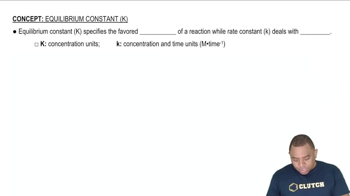
Equilibrium Constant (K)

The equilibrium constant (K) is a numerical value that expresses the ratio of the concentrations of products to reactants at equilibrium for a given chemical reaction. It is temperature-dependent and provides insight into the extent of a reaction; a large K indicates a reaction that favors products, while a small K suggests a preference for reactants.
추천 영상:
가이드 코스
01:14
Equilibrium Constant K

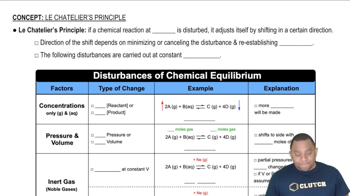
Le Chatelier's Principle

Le Chatelier's Principle states that if a dynamic equilibrium is disturbed by changing the conditions, the system will adjust itself to counteract the change and restore a new equilibrium. This principle helps predict how changes in concentration, pressure, or temperature will affect the position of equilibrium and, consequently, the value of K.
추천 영상:
가이드 코스
07:32
Le Chatelier's Principle

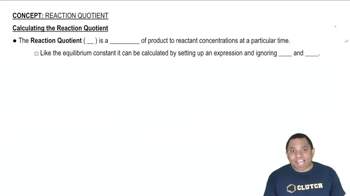
Reaction Quotient (Q)

The reaction quotient (Q) is a measure of the relative concentrations of products and reactants at any point in time during a reaction. It is calculated using the same formula as the equilibrium constant but with concentrations that are not necessarily at equilibrium. Comparing Q to K allows us to determine the direction in which a reaction will proceed to reach equilibrium.
추천 영상:
가이드 코스
00:49
Reaction Quotient Q