Ch.20 - Electrochemistry
20์žฅ, ๋ฌธ์ œ 70a

Use tabulated electrode potentials to calculate ๐›ฅ๐บrxnยฐ for each reaction at 25 ยฐC. a. MnO2(s) + 4 H+(aq) + Cu(s)ยกMn2+(aq) + 2 H2O(l) + Cu2+(aq)

๊ฒ€์ฆ๋œ ๋‹จ๊ณ„๋ณ„ ์•ˆ๋‚ด
1
Identify the half-reactions involved in the given redox reaction.
Write the reduction half-reaction and find its standard reduction potential (Eยฐ).
Write the oxidation half-reaction and find its standard oxidation potential (Eยฐ).
Calculate the standard cell potential (Eยฐcell) by subtracting the oxidation potential from the reduction potential.
Use the formula ๐›ฅ๐บยฐ = -nFEยฐcell to calculate the standard Gibbs free energy change, where n is the number of moles of electrons transferred and F is the Faraday constant.

๋น„์Šทํ•œ ๋ฌธ์ œ์— ๋Œ€ํ•œ ๊ฒ€์ฆ๋œ ์˜์ƒ ๋‹ต๋ณ€:

์ด ์˜์ƒ ํ•ด๋ฒ•์€ ์œ„ ๋ฌธ์ œ์— ๋„์›€์ด ๋œ๋‹ค๊ณ  ํŠœํ„ฐ๋“ค์ด ์ถ”์ฒœํ•œ ๊ฒƒ์ž…๋‹ˆ๋‹ค.
์˜์ƒ ๊ธธ์ด:
8m
๋„์›€์ด ๋˜์—ˆ๋‚˜์š”?

์ฃผ์š” ๊ฐœ๋…

์งˆ๋ฌธ์— ์˜ฌ๋ฐ”๋ฅด๊ฒŒ ๋‹ตํ•˜๊ธฐ ์œ„ํ•ด ๋ฐ˜๋“œ์‹œ ์ดํ•ดํ•ด์•ผ ํ•˜๋Š” ํ•ต์‹ฌ ๊ฐœ๋…๋“ค์€ ๋‹ค์Œ๊ณผ ๊ฐ™์Šต๋‹ˆ๋‹ค.

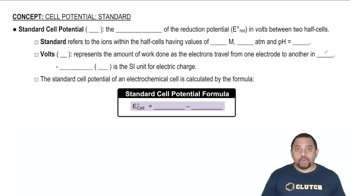
Electrode Potentials

Electrode potentials, measured in volts, indicate the tendency of a chemical species to be reduced. Standard electrode potentials (Eยฐ) are measured under standard conditions (1 M concentration, 1 atm pressure, and 25 ยฐC) and are used to predict the direction of redox reactions. A higher Eยฐ value suggests a greater likelihood of reduction, which is essential for calculating Gibbs free energy changes in electrochemical reactions.
์ถ”์ฒœ ์˜์ƒ:

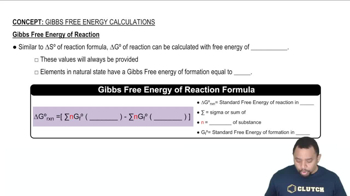
Gibbs Free Energy (ฮ”G)

Gibbs free energy (ฮ”G) is a thermodynamic quantity that indicates the spontaneity of a reaction. It is calculated using the equation ฮ”G = ฮ”Gยฐ + RT ln(Q), where ฮ”Gยฐ is the standard Gibbs free energy change, R is the gas constant, T is the temperature in Kelvin, and Q is the reaction quotient. A negative ฮ”G indicates a spontaneous reaction, while a positive ฮ”G suggests non-spontaneity.
์ถ”์ฒœ ์˜์ƒ:

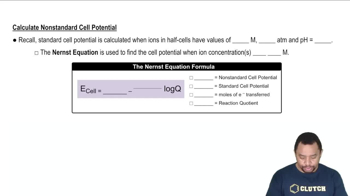
Nernst Equation

The Nernst equation relates the electrode potential of a half-cell to the concentrations of the reactants and products involved in the redox reaction. It is expressed as E = Eยฐ - (RT/nF) ln(Q), where E is the cell potential, Eยฐ is the standard potential, n is the number of moles of electrons transferred, and F is Faraday's constant. This equation is crucial for calculating the Gibbs free energy change in electrochemical reactions at non-standard conditions.
์ถ”์ฒœ ์˜์ƒ: