Ch.20 - Electrochemistry
20์žฅ, ๋ฌธ์ œ 70c

Use tabulated electrode potentials to calculate ๐›ฅ๐บrxnยฐ for each reaction at 25 ยฐC. c. Br2(l) + 2Clโ€“(aq) โ†’ 2 Brโ€“(aq) + Cl2(g)

๊ฒ€์ฆ๋œ ๋‹จ๊ณ„๋ณ„ ์•ˆ๋‚ด
1
Identify the half-reactions involved in the given redox reaction. The oxidation half-reaction is: 2Cl^- \(\rightarrow\) Cl_2 + 2e^-. The reduction half-reaction is: Br_2 + 2e^- \(\rightarrow\) 2Br^-.
Look up the standard electrode potentials (Eยฐ) for each half-reaction from a table of standard reduction potentials. Note that the potential for the oxidation reaction will be the negative of the reduction potential for Cl_2.
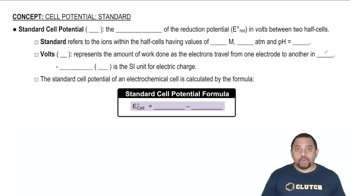
Calculate the standard cell potential (Eยฐ_cell) for the reaction using the formula: Eยฐ_cell = Eยฐ_cathode - Eยฐ_anode.
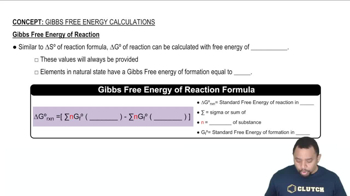
Use the Nernst equation to relate the standard cell potential to the standard Gibbs free energy change: \(\Delta\) Gยฐ_{rxn} = -nFEยฐ_{cell}, where n is the number of moles of electrons transferred (which is 2 in this case), and F is the Faraday constant (approximately 96485 C/mol).
Substitute the values for n, F, and Eยฐ_{cell} into the equation to calculate \(\Delta\) Gยฐ_{rxn}.

๋น„์Šทํ•œ ๋ฌธ์ œ์— ๋Œ€ํ•œ ๊ฒ€์ฆ๋œ ์˜์ƒ ๋‹ต๋ณ€:

์ด ์˜์ƒ ํ•ด๋ฒ•์€ ์œ„ ๋ฌธ์ œ์— ๋„์›€์ด ๋œ๋‹ค๊ณ  ํŠœํ„ฐ๋“ค์ด ์ถ”์ฒœํ•œ ๊ฒƒ์ž…๋‹ˆ๋‹ค.
์˜์ƒ ๊ธธ์ด:
8m
๋„์›€์ด ๋˜์—ˆ๋‚˜์š”?

์ฃผ์š” ๊ฐœ๋…

์งˆ๋ฌธ์— ์˜ฌ๋ฐ”๋ฅด๊ฒŒ ๋‹ตํ•˜๊ธฐ ์œ„ํ•ด ๋ฐ˜๋“œ์‹œ ์ดํ•ดํ•ด์•ผ ํ•˜๋Š” ํ•ต์‹ฌ ๊ฐœ๋…๋“ค์€ ๋‹ค์Œ๊ณผ ๊ฐ™์Šต๋‹ˆ๋‹ค.

Electrode Potentials

Electrode potentials, measured in volts, indicate the tendency of a chemical species to be reduced. Standard electrode potentials (Eยฐ) are measured under standard conditions and are crucial for predicting the direction of redox reactions. The more positive the electrode potential, the greater the species' ability to gain electrons and undergo reduction.
์ถ”์ฒœ ์˜์ƒ:

Gibbs Free Energy (ฮ”G)

Gibbs Free Energy (ฮ”G) is a thermodynamic quantity that indicates the spontaneity of a reaction. It combines enthalpy and entropy to determine whether a reaction can occur spontaneously at constant temperature and pressure. A negative ฮ”G value signifies a spontaneous reaction, while a positive value indicates non-spontaneity.
์ถ”์ฒœ ์˜์ƒ:

Nernst Equation

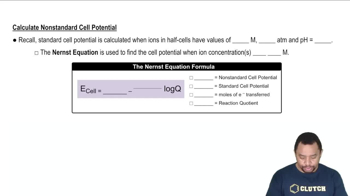
The Nernst Equation relates the electrode potential of a half-cell to the concentrations of the reactants and products involved in the redox reaction. It allows for the calculation of the cell potential under non-standard conditions, which is essential for determining the Gibbs Free Energy change (ฮ”G) for a reaction. The equation is given by E = Eยฐ - (RT/nF)ln(Q), where Q is the reaction quotient.
์ถ”์ฒœ ์˜์ƒ: