Ch.21 - Radioactivity & Nuclear Chemistry
Tro - Chemistry: A Molecular Approach 6th Edition
Tro6th EditionChemistry: A Molecular ApproachISBN: 9780137832217당신이 사용하는 게 아니라요?교과서 변경
21장, 문제 37c

Determine whether or not each nuclide is likely to be stable. State your reasons. c. Ag-98

검증된 단계별 안내
1
Identify the atomic number of silver (Ag), which is 47, and note that Ag-98 has 98 nucleons (protons + neutrons).
Calculate the number of neutrons in Ag-98 by subtracting the atomic number from the mass number: 98 - 47 = 51 neutrons.
Determine the neutron-to-proton (n/p) ratio by dividing the number of neutrons by the number of protons: 51/47.
Compare the n/p ratio to the typical stability range for elements around silver. For elements with atomic numbers around 47, a stable n/p ratio is usually close to 1.3 to 1.5.
Consider additional factors such as magic numbers and odd-even rules. Check if the number of protons or neutrons corresponds to a magic number, which often indicates stability, and note that nuclides with even numbers of both protons and neutrons tend to be more stable.

비슷한 문제에 대한 검증된 영상 답변:

이 영상 해법은 위 문제에 도움이 된다고 튜터들이 추천한 것입니다.
영상 길이:
1m
도움이 되었나요?

주요 개념

질문에 올바르게 답하기 위해 반드시 이해해야 하는 핵심 개념들은 다음과 같습니다.

Nuclear Stability

Nuclear stability refers to the ability of a nucleus to remain intact without undergoing radioactive decay. Stable nuclides have a balanced ratio of protons to neutrons, which helps to counteract the repulsive forces between positively charged protons. Generally, nuclides with a neutron-to-proton ratio close to 1:1 are more likely to be stable, while those with significantly higher or lower ratios tend to be unstable.
추천 영상:
가이드 코스
03:29
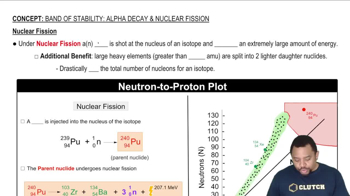
Band of Stability: Nuclear Fission

Isotopes

Isotopes are variants of a chemical element that have the same number of protons but different numbers of neutrons. This difference in neutron count can affect the stability of the nuclide. For example, silver (Ag) has several isotopes, and while some are stable, others, like Ag-98, may be radioactive and thus unstable, leading to decay over time.
추천 영상:

Binding Energy

Binding energy is the energy required to disassemble a nucleus into its constituent protons and neutrons. A higher binding energy indicates a more stable nucleus, as it suggests that the nucleons are held together more tightly. The stability of a nuclide can often be assessed by comparing its binding energy per nucleon; those with higher values are generally more stable.
추천 영상:
가이드 코스
02:06
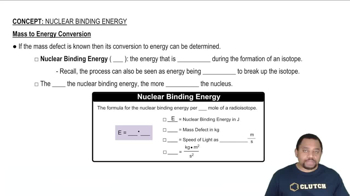
Nuclear Binding Energy