Ch.21 - Radioactivity & Nuclear Chemistry
Tro - Chemistry: A Molecular Approach 6th Edition
Tro6th EditionChemistry: A Molecular ApproachISBN: 9780137832217당신이 사용하는 게 아니라요?교과서 변경
21장, 문제 39

The first six elements of the first transition series have the following number of stable isotopes:
Element Number of Stable Isotopes
Sc 1
Ti 5
V 1
Cr 3
Mn 1
Fe 4
Explain why Sc, V, and Mn each have only one stable isotope while the other elements have several.

검증된 단계별 안내
1
insert step 1> Consider the concept of nuclear stability, which is influenced by the ratio of neutrons to protons in an atomic nucleus.
insert step 2> Recognize that elements with only one stable isotope, like Sc, V, and Mn, have a specific neutron-to-proton ratio that results in a stable nucleus.
insert step 3> Understand that for these elements, any deviation from this ratio results in an unstable nucleus, leading to radioactive decay.
insert step 4> Compare this to elements like Ti, Cr, and Fe, which have multiple stable isotopes, indicating a range of neutron-to-proton ratios that can still result in nuclear stability.
insert step 5> Conclude that the presence of only one stable isotope for Sc, V, and Mn is due to the limited range of neutron-to-proton ratios that maintain stability for these specific elements.

비슷한 문제에 대한 검증된 영상 답변:

이 영상 해법은 위 문제에 도움이 된다고 튜터들이 추천한 것입니다.
영상 길이:
1m

주요 개념

질문에 올바르게 답하기 위해 반드시 이해해야 하는 핵심 개념들은 다음과 같습니다.

Isotopes and Stability

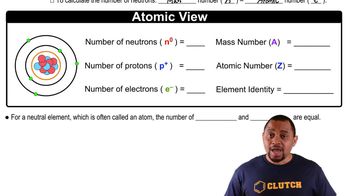
Isotopes are variants of a chemical element that have the same number of protons but different numbers of neutrons. The stability of an isotope is determined by the balance between the nuclear forces that hold the nucleus together and the repulsive forces between protons. Stable isotopes do not undergo radioactive decay, while unstable isotopes do. The stability of isotopes can vary significantly among elements, influencing the number of stable isotopes an element possesses.
추천 영상:

Nuclear Binding Energy

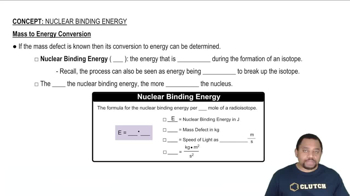
Nuclear binding energy is the energy required to disassemble a nucleus into its constituent protons and neutrons. It is a measure of the stability of a nucleus; higher binding energy generally indicates a more stable nucleus. The ratio of neutrons to protons plays a crucial role in determining binding energy, as certain ratios lead to more stable configurations. Elements with a favorable neutron-to-proton ratio tend to have multiple stable isotopes, while those with less favorable ratios may have only one.
추천 영상:
가이드 코스
02:06
Nuclear Binding Energy

Magic Numbers in Nuclear Physics

Magic numbers refer to specific numbers of protons or neutrons in a nucleus that result in a more stable configuration due to complete energy levels. For example, nuclei with magic numbers of protons or neutrons exhibit greater stability and are less likely to undergo decay. The first transition series elements exhibit varying stability based on their neutron and proton counts relative to these magic numbers, explaining why some elements like Sc, V, and Mn have only one stable isotope while others have multiple.
추천 영상:
가이드 코스
02:06
Nuclear Binding Energy