Ch.21 - Radioactivity & Nuclear Chemistry
Tro - Chemistry: A Molecular Approach 6th Edition
Tro6th EditionChemistry: A Molecular ApproachISBN: 9780137832217당신이 사용하는 게 아니라요?교과서 변경
21장, 문제 41a

Predict a likely mode of decay for each unstable nuclide. a. Ca-35

검증된 단계별 안내
1
Identify the atomic number and mass number of the nuclide. Calcium (Ca) has an atomic number of 20, and the nuclide in question is Ca-35, which means it has a mass number of 35.
Calculate the number of neutrons by subtracting the atomic number from the mass number: Neutrons = Mass number - Atomic number = 35 - 20.
Determine the neutron-to-proton (n/p) ratio. For Ca-35, calculate the ratio using the number of neutrons and protons.
Compare the n/p ratio to the stable n/p ratio for elements around calcium. Typically, for lighter elements, a stable n/p ratio is close to 1:1.
Predict the mode of decay based on the n/p ratio. If the n/p ratio is too high, beta decay is likely, where a neutron is converted into a proton, emitting a beta particle.

비슷한 문제에 대한 검증된 영상 답변:

이 영상 해법은 위 문제에 도움이 된다고 튜터들이 추천한 것입니다.
영상 길이:
38s
도움이 되었나요?

주요 개념

질문에 올바르게 답하기 위해 반드시 이해해야 하는 핵심 개념들은 다음과 같습니다.

Nuclear Decay

Nuclear decay refers to the process by which an unstable atomic nucleus loses energy by emitting radiation. This can occur through various modes, including alpha decay, beta decay, and gamma decay, each characterized by the type of particle or energy released. Understanding the stability of a nuclide and the forces at play within the nucleus is essential for predicting its decay mode.
추천 영상:

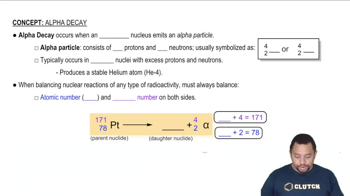
Alpha Decay

Alpha decay is a type of radioactive decay in which an unstable nucleus emits an alpha particle, consisting of two protons and two neutrons. This process reduces the atomic number by two and the mass number by four, resulting in the formation of a new element. Alpha decay typically occurs in heavy nuclides, where the strong nuclear force is insufficient to hold the nucleus together.
추천 영상:

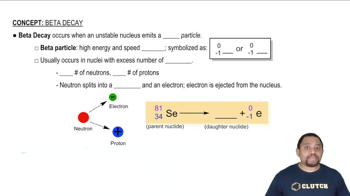
Beta Decay

Beta decay is a radioactive decay process where a neutron in the nucleus is transformed into a proton, or vice versa, resulting in the emission of a beta particle (an electron or positron). This process changes the atomic number of the nuclide, leading to the formation of a different element. Beta decay is common in nuclides that are neutron-rich or proton-rich, helping to stabilize the nucleus.
추천 영상: