Ch.5 - Introduction to Solutions and Aqueous Solutions
Tro - Chemistry: A Molecular Approach 6th Edition
Tro6th EditionChemistry: A Molecular ApproachISBN: 9780137832217당신이 사용하는 게 아니라요?교과서 변경
5장, 문제 39

To what volume should you dilute 50.0 mL of a 12 M stock HNO3 solution to obtain a 0.100 M HNO3 solution?

검증된 단계별 안내
1
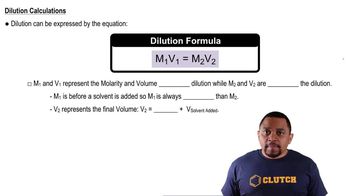
Identify the dilution formula: \( C_1V_1 = C_2V_2 \), where \( C_1 \) and \( V_1 \) are the concentration and volume of the stock solution, and \( C_2 \) and \( V_2 \) are the concentration and volume of the diluted solution.
Substitute the known values into the formula: \( 12 \text{ M} \times 50.0 \text{ mL} = 0.100 \text{ M} \times V_2 \).
Rearrange the equation to solve for \( V_2 \): \( V_2 = \frac{12 \text{ M} \times 50.0 \text{ mL}}{0.100 \text{ M}} \).
Calculate the value of \( V_2 \) to find the total volume of the diluted solution.
The result will give you the volume to which you need to dilute the stock solution to achieve the desired concentration.

비슷한 문제에 대한 검증된 영상 답변:

이 영상 해법은 위 문제에 도움이 된다고 튜터들이 추천한 것입니다.
영상 길이:
1m

주요 개념

질문에 올바르게 답하기 위해 반드시 이해해야 하는 핵심 개념들은 다음과 같습니다.

Dilution Principle

The dilution principle states that when a solution is diluted, the number of moles of solute remains constant. This can be expressed mathematically as C1V1 = C2V2, where C1 and V1 are the concentration and volume of the stock solution, and C2 and V2 are the concentration and volume of the diluted solution.
추천 영상:
가이드 코스
00:58
Dilution Equation

Molarity (M)

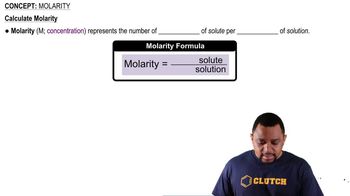
Molarity is a measure of concentration defined as the number of moles of solute per liter of solution. It is expressed in moles per liter (mol/L). Understanding molarity is crucial for calculating how much of a stock solution is needed to achieve a desired concentration in a diluted solution.
추천 영상:
가이드 코스
00:53
Molarity Concept

Volume Calculation

Volume calculation involves determining the final volume of a solution after dilution. In the context of the dilution principle, once the initial volume and concentration are known, the final volume can be calculated using the rearranged formula V2 = (C1V1) / C2, allowing for the preparation of solutions with specific concentrations.
추천 영상:
가이드 코스
02:35
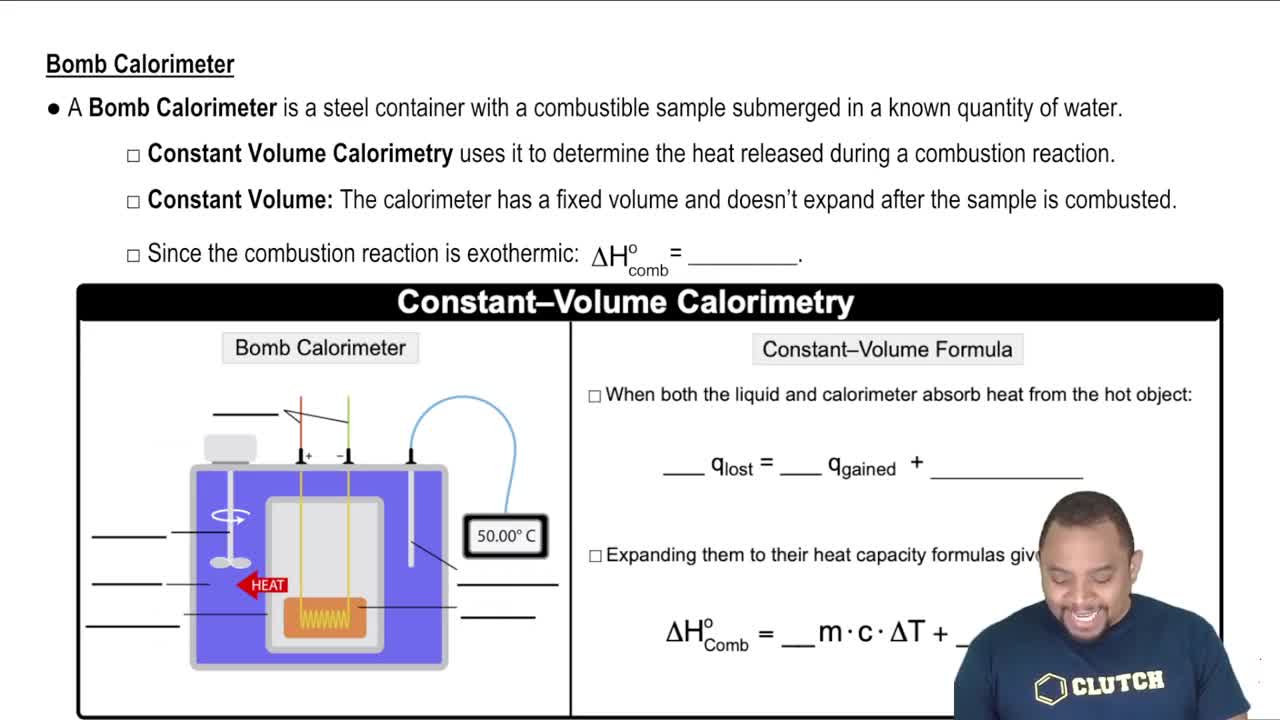
Constant-Volume Calorimetry