Ch. 10 - DNA Replication
Klug - Essentials of Genetics 10th Edition
Klug10th EditionEssentials of GeneticsISBN: 9780135588789당신이 사용하는 게 아니라요?교과서 변경
10장, 문제 14

Distinguish between
(a) unidirectional and bidirectional synthesis, and
(b) continuous and discontinuous synthesis of DNA.

검증된 단계별 안내
1
Step 1: Define unidirectional synthesis of DNA as the process where DNA replication proceeds in only one direction from the origin of replication, meaning the replication fork moves in a single direction along the DNA strand.
Step 2: Define bidirectional synthesis of DNA as the process where replication starts at a specific origin and proceeds in two opposite directions simultaneously, creating two replication forks moving away from the origin.
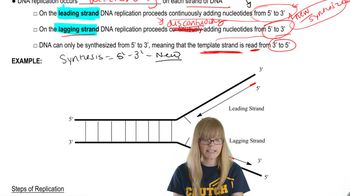
Step 3: Explain continuous synthesis of DNA as the process occurring on the leading strand, where DNA polymerase synthesizes a new strand continuously in the 5' to 3' direction as the replication fork opens.
Step 4: Explain discontinuous synthesis of DNA as the process occurring on the lagging strand, where DNA polymerase synthesizes short fragments called Okazaki fragments in the 5' to 3' direction, which are later joined together to form a continuous strand.
Step 5: Summarize the differences by highlighting that unidirectional vs. bidirectional synthesis refers to the directionality of replication forks, while continuous vs. discontinuous synthesis refers to the mode of strand elongation on the leading and lagging strands, respectively.

비슷한 문제에 대한 검증된 영상 답변:

이 영상 해법은 위 문제에 도움이 된다고 튜터들이 추천한 것입니다.
영상 길이:
2m
도움이 되었나요?

주요 개념

질문에 올바르게 답하기 위해 반드시 이해해야 하는 핵심 개념들은 다음과 같습니다.

Unidirectional vs. Bidirectional DNA Synthesis

Unidirectional DNA synthesis occurs when replication proceeds in only one direction from the origin, producing a single replication fork. In contrast, bidirectional synthesis involves two replication forks moving in opposite directions from the origin, allowing faster and more efficient DNA replication.
추천 영상:

Continuous DNA Synthesis

Continuous DNA synthesis refers to the process where the new DNA strand is synthesized smoothly and continuously in the 5' to 3' direction on the leading strand, following the replication fork movement without interruption.
추천 영상:
가이드 코스
02:43
Translesion Synthesis

Discontinuous DNA Synthesis

Discontinuous DNA synthesis occurs on the lagging strand, where DNA is synthesized in short fragments called Okazaki fragments. These fragments are later joined together by DNA ligase to form a continuous strand, due to the antiparallel nature of DNA and the 5' to 3' synthesis direction.
추천 영상:
가이드 코스
02:43
Translesion Synthesis