
Ch. 10 - DNA Replication
Klug - Essentials of Genetics 10th Edition
Klug10th EditionEssentials of GeneticsISBN: 9780135588789당신이 사용하는 게 아니라요?교과서 변경
10장, 문제 1a

In the discussion, we focused on how DNA is replicated and synthesized. We also discussed recombination at the DNA level. Along the way, we encountered many opportunities to consider how this information was acquired. On the basis of these discussions, what answers would you propose to the following fundamental questions?
What is the experimental basis for concluding that DNA replicates semiconservatively in both bacteria and eukaryotes?

검증된 단계별 안내
1
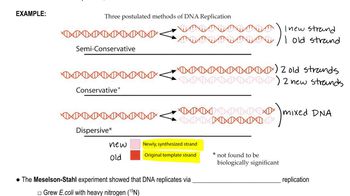
Step 1: Understand the concept of semiconservative replication, which means that each new DNA molecule consists of one original (parental) strand and one newly synthesized strand.
Step 2: Review the classic Meselson-Stahl experiment, which provided the experimental evidence for semiconservative replication in bacteria. This involved growing bacteria in a medium containing heavy nitrogen isotope (\(^{15}N\)) and then shifting them to a medium with light nitrogen isotope (\(^{14}N\)).
Step 3: Recognize that after DNA replication, the DNA was extracted and subjected to density gradient centrifugation, which separates DNA molecules based on their density. The position of DNA bands in the gradient indicated whether DNA was heavy, light, or hybrid (intermediate density).
Step 4: Analyze the pattern of DNA bands after successive rounds of replication. The presence of hybrid DNA after one replication cycle and a mixture of hybrid and light DNA after the second cycle supports the semiconservative model.
Step 5: Extend this understanding to eukaryotes by considering similar experimental approaches, such as labeling newly synthesized DNA with nucleotide analogs (e.g., bromodeoxyuridine) and using density gradient centrifugation or autoradiography to demonstrate semiconservative replication.

비슷한 문제에 대한 검증된 영상 답변:

이 영상 해법은 위 문제에 도움이 된다고 튜터들이 추천한 것입니다.
영상 길이:
2m
도움이 되었나요?

주요 개념

질문에 올바르게 답하기 위해 반드시 이해해야 하는 핵심 개념들은 다음과 같습니다.

Semiconservative DNA Replication

Semiconservative replication means that each new DNA molecule consists of one original (parental) strand and one newly synthesized strand. This model contrasts with conservative and dispersive models, and it explains how genetic information is accurately passed to daughter cells during cell division.
추천 영상:
가이드 코스
14:31
Semiconservative Replication

Meselson-Stahl Experiment

The Meselson-Stahl experiment used isotopic labeling of DNA with heavy (15N) and light (14N) nitrogen to track DNA replication in bacteria. Their results showed intermediate density DNA after one replication cycle, supporting the semiconservative model by demonstrating that each daughter DNA contains one old and one new strand.
추천 영상:
가이드 코스
08:06
Mendel's Experiments

DNA Replication in Eukaryotes

In eukaryotes, semiconservative replication is supported by experiments using density gradient centrifugation and molecular markers, showing similar patterns to bacteria. Additionally, replication origins and replication forks have been visualized, confirming that each daughter DNA inherits one parental strand and one new strand.
추천 영상:
가이드 코스
11:59
Steps to DNA Replication