Ch. 10 - DNA Replication
Klug - Essentials of Genetics 10th Edition
Klug10th EditionEssentials of GeneticsISBN: 9780135588789당신이 사용하는 게 아니라요?교과서 변경
10장, 문제 1d

In the discussion, we focused on how DNA is replicated and synthesized. We also discussed recombination at the DNA level. Along the way, we encountered many opportunities to consider how this information was acquired. On the basis of these discussions, what answers would you propose to the following fundamental questions?
How do we know that DNA synthesis is discontinuous on one of the two template strands?

검증된 단계별 안내
1
Recall that DNA replication involves synthesizing new strands complementary to each original template strand, and that the two strands are antiparallel, meaning they run in opposite directions.
Understand that DNA polymerase can only add nucleotides in the 5' to 3' direction, which creates a challenge for replicating the strand oriented 3' to 5'.
Recognize that experimental evidence, such as the discovery of Okazaki fragments, showed that the strand synthesized in the 3' to 5' direction is made in short segments rather than continuously.
Consider the method used in pulse-chase experiments where radioactive nucleotides were incorporated into newly synthesized DNA, revealing short DNA fragments on one strand that were later joined together.
Conclude that these observations demonstrate DNA synthesis is continuous on the leading strand (5' to 3' direction) and discontinuous on the lagging strand (3' to 5' direction), requiring the synthesis of Okazaki fragments that are later ligated.

비슷한 문제에 대한 검증된 영상 답변:

이 영상 해법은 위 문제에 도움이 된다고 튜터들이 추천한 것입니다.
영상 길이:
2m
도움이 되었나요?

주요 개념

질문에 올바르게 답하기 위해 반드시 이해해야 하는 핵심 개념들은 다음과 같습니다.

Semiconservative DNA Replication

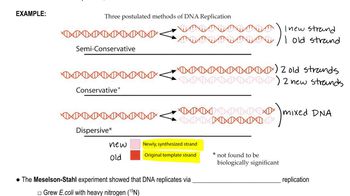
DNA replication involves each of the two original strands serving as a template for a new complementary strand, resulting in two DNA molecules each with one old and one new strand. This model explains how genetic information is accurately copied and is foundational to understanding replication mechanisms.
추천 영상:
가이드 코스
14:31
Semiconservative Replication

Leading and Lagging Strand Synthesis

During DNA replication, one strand (leading) is synthesized continuously in the 5' to 3' direction, while the other strand (lagging) is synthesized discontinuously in short fragments called Okazaki fragments. This occurs because DNA polymerase can only add nucleotides in one direction, necessitating a different mode of synthesis on the antiparallel strand.
추천 영상:
가이드 코스
02:43
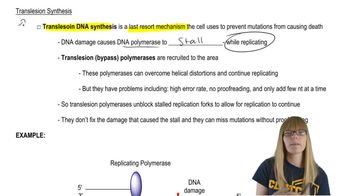
Translesion Synthesis

Okazaki Fragments and Experimental Evidence

Okazaki fragments are short DNA segments formed on the lagging strand during replication. Their discovery through pulse-labeling experiments with radioactive nucleotides provided direct evidence that DNA synthesis is discontinuous on one strand, confirming the bidirectional and asymmetric nature of DNA replication.
추천 영상:
가이드 코스
11:59
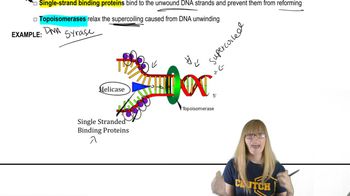
Steps to DNA Replication
관련 실천
교과서 질문

Compare conservative, semiconservative, and dispersive modes of DNA replication.

1299
views

교과서 질문

In the discussion, we focused on how DNA is replicated and synthesized. We also discussed recombination at the DNA level. Along the way, we encountered many opportunities to consider how this information was acquired. On the basis of these discussions, what answers would you propose to the following fundamental questions?

What is the experimental basis for concluding that DNA replicates semiconservatively in both bacteria and eukaryotes?

567
views
교과서 질문

In the discussion, we focused on how DNA is replicated and synthesized. We also discussed recombination at the DNA level. Along the way, we encountered many opportunities to consider how this information was acquired. On the basis of these discussions, what answers would you propose to the following fundamental questions?

How do we know that in vivo DNA synthesis occurs in the 5' to 3' direction?

660
views
교과서 질문

In the discussion, we focused on how DNA is replicated and synthesized. We also discussed recombination at the DNA level. Along the way, we encountered many opportunities to consider how this information was acquired. On the basis of these discussions, what answers would you propose to the following fundamental questions?

What observations reveal that a 'telomere problem' exists during eukaryotic DNA replication, and how did we learn of the solution to this problem?

558
views
교과서 질문

Write a short essay that distinguishes between the terms replication and synthesis, as applied to DNA. Which of the two is most closely allied with the field of biochemistry?

716
views