Ch. 10 - DNA Replication
Klug - Essentials of Genetics 10th Edition
Klug10th EditionEssentials of GeneticsISBN: 9780135588789당신이 사용하는 게 아니라요?교과서 변경
10장, 문제 5

Predict the results of the experiment by Taylor, Woods, and Hughes if replication were
(a) conservative and
(b) dispersive.

검증된 단계별 안내
1
Step 1: Understand the original experiment by Taylor, Woods, and Hughes, which used radioactive thymidine to label DNA and track replication patterns in chromosomes. The key observation was the distribution of labeled and unlabeled DNA after one and two rounds of replication.
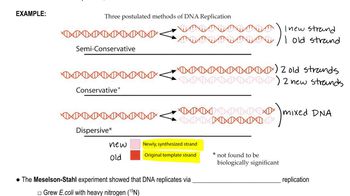
Step 2: For the conservative replication model, predict that after one round of replication, one daughter DNA molecule would be fully labeled (containing the original labeled strand) and the other would be completely unlabeled (newly synthesized strands). After the second round, you would expect a similar pattern with a mix of fully labeled and fully unlabeled DNA molecules.
Step 3: For the dispersive replication model, predict that after one round of replication, all DNA molecules would contain a mixture of labeled and unlabeled segments within each strand, resulting in intermediate labeling throughout. After the second round, the label would be further diluted but still present in all DNA molecules, with no fully labeled or fully unlabeled strands.
Step 4: Compare these predictions to the actual experimental results, which showed semi-conservative replication, where each daughter molecule contains one labeled (old) strand and one unlabeled (new) strand after the first replication.
Step 5: Summarize that the conservative model predicts distinct fully labeled and unlabeled DNA molecules, while the dispersive model predicts uniformly mixed labeling in all DNA molecules, which contrasts with the semi-conservative pattern observed by Taylor, Woods, and Hughes.

비슷한 문제에 대한 검증된 영상 답변:

이 영상 해법은 위 문제에 도움이 된다고 튜터들이 추천한 것입니다.
영상 길이:
41s
도움이 되었나요?

주요 개념

질문에 올바르게 답하기 위해 반드시 이해해야 하는 핵심 개념들은 다음과 같습니다.

DNA Replication Models

DNA replication can occur via three models: conservative, semiconservative, and dispersive. The conservative model suggests the original DNA molecule remains intact while a completely new copy is made. Understanding these models is essential to predict experimental outcomes related to DNA synthesis.
추천 영상:
가이드 코스
11:59
Steps to DNA Replication

Taylor, Woods, and Hughes Experiment

This experiment used radioactive thymidine to track DNA replication in root tip cells of Vicia faba. By analyzing chromosome labeling patterns after replication, they provided evidence supporting the semiconservative model. Knowing the experiment's design helps predict results under alternative replication models.
추천 영상:
가이드 코스
08:06
Mendel's Experiments

Predicted Outcomes of Conservative and Dispersive Replication

In conservative replication, one daughter molecule is fully labeled and the other unlabeled after one replication round. In dispersive replication, DNA strands are hybrids of old and new segments, resulting in uniformly mixed labeling. These patterns differ from semiconservative replication and are key to interpreting experimental data.
추천 영상:
가이드 코스
14:31
Semiconservative Replication