Most center around DNA and RNA and their role of serving as the genetic material. Write a short essay that contrasts these molecules, including a comparison of advantages conferred by their structure that each of them has over the other in serving in this role.
Ch. 10 - DNA Structure and Analysis

10장, 문제 5
When Avery and his colleagues had obtained what was concluded to be the transforming factor from the IIIS virulent cells, they treated the fraction with proteases, RNase, and DNase, followed in each case by the assay for retention or loss of transforming ability. What were the purpose and results of these experiments? What conclusions were drawn?
검증된 단계별 안내1
Step 1: Understand the context of Avery's experiment, which aimed to identify the 'transforming factor' responsible for transferring genetic information from virulent IIIS cells to non-virulent IIR cells, causing transformation.
Step 2: Recognize that Avery and colleagues treated the purified transforming material with three different enzymes: proteases (which degrade proteins), RNase (which degrades RNA), and DNase (which degrades DNA), to determine which type of molecule was responsible for transformation.
Step 3: Analyze the purpose of each treatment: proteases tested if proteins were the transforming factor, RNase tested if RNA was responsible, and DNase tested if DNA was the transforming molecule.
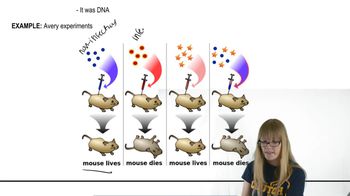
Step 4: Note the results: treatment with proteases and RNase did not abolish the transforming ability, meaning transformation still occurred, whereas treatment with DNase destroyed the transforming ability, indicating that DNA was necessary for transformation.
Step 5: Conclude that the transforming factor was DNA, as only DNase treatment eliminated the ability to transform non-virulent cells, providing strong evidence that DNA carries genetic information.

비슷한 문제에 대한 검증된 영상 답변:
이 영상 해법은 위 문제에 도움이 된다고 튜터들이 추천한 것입니다.
영상 길이:
1m도움이 되었나요?
주요 개념
질문에 올바르게 답하기 위해 반드시 이해해야 하는 핵심 개념들은 다음과 같습니다.
Transforming Principle
The transforming principle refers to the substance responsible for transferring genetic information from one bacterial strain to another, as demonstrated in Griffith's experiment. Avery and colleagues aimed to identify this factor by isolating it from virulent IIIS cells and testing its ability to transform non-virulent bacteria.
추천 영상:
가이드 코스
Transformation
Enzymatic Treatment to Identify Macromolecules
Proteases, RNase, and DNase are enzymes that degrade proteins, RNA, and DNA respectively. By treating the transforming factor with these enzymes, Avery's team tested which macromolecule was essential for transformation, observing whether the ability to transform bacteria was lost after each treatment.
추천 영상:
가이드 코스
Cancer Characteristics
DNA as the Genetic Material
The experiments showed that only DNase treatment destroyed the transforming ability, indicating DNA was the transforming factor. This provided strong evidence that DNA, not protein or RNA, carries genetic information, a foundational discovery in molecular genetics.
추천 영상:
가이드 코스
History and Experiments
관련 실천
교과서 질문
465
views
교과서 질문
What observations are consistent with the conclusion that DNA serves as the genetic material in eukaryotes? List and discuss them.
820
views
교과서 질문
Does the design of the Hershey–Chase experiment distinguish between DNA and RNA as the molecule serving as the genetic material? Why or why not?
990
views
교과서 질문
Why were ³²P and ³⁵S chosen for use in the Hershey–Chase experiment? Discuss the rationale and conclusions of this experiment.
824
views
교과서 질문
Discuss the reasons proteins were generally favored over DNA as the genetic material before 1940. What was the role of the tetranucleotide hypothesis in this controversy?
1118
views
교과서 질문
Contrast the contributions made to an understanding of transformation by Griffith and by Avery and his colleagues.
632
views
