Ch. 10 - DNA Structure and Analysis
Klug - Concepts of Genetics  12th Edition
Klug12th EditionConcepts of Genetics ISBN: 9780135564776당신이 사용하는 게 아니라요?교과서 변경
10장, 문제 7

Does the design of the Hershey–Chase experiment distinguish between DNA and RNA as the molecule serving as the genetic material? Why or why not?

검증된 단계별 안내
1
Step 1: Understand the goal of the Hershey–Chase experiment, which was to determine whether DNA or protein is the genetic material in bacteriophages (viruses that infect bacteria).
Step 2: Review the experimental design: Hershey and Chase used two different radioactive isotopes to label the components of the phage. They labeled DNA with radioactive phosphorus-32 (\(^{32}P\)) because DNA contains phosphorus, and they labeled protein with radioactive sulfur-35 (\(^{35}S\)) because proteins contain sulfur but DNA does not.
Step 3: Analyze what happens during the experiment: After allowing the labeled phages to infect bacteria, they used a blender to separate the phage protein coats from the bacterial cells and then measured radioactivity in the bacteria and in the phage coats.
Step 4: Consider whether the experiment distinguishes DNA from RNA: Since the radioactive label for nucleic acids was phosphorus-32, which labels all nucleic acids (both DNA and RNA contain phosphorus), the experiment does not specifically distinguish DNA from RNA. It only distinguishes nucleic acids from proteins.
Step 5: Conclude that the Hershey–Chase experiment demonstrated that nucleic acids (DNA or RNA) enter the bacterial cells and carry genetic information, but it does not differentiate between DNA and RNA as the genetic material. Additional evidence was needed to confirm that DNA, not RNA, is the genetic material.

비슷한 문제에 대한 검증된 영상 답변:

이 영상 해법은 위 문제에 도움이 된다고 튜터들이 추천한 것입니다.
영상 길이:
2m
도움이 되었나요?

주요 개념

질문에 올바르게 답하기 위해 반드시 이해해야 하는 핵심 개념들은 다음과 같습니다.

Hershey–Chase Experiment Design

The Hershey–Chase experiment used bacteriophages labeled with radioactive isotopes to track DNA and protein during infection. Phosphorus-32 labeled DNA, while sulfur-35 labeled protein, allowing researchers to determine which molecule entered bacterial cells. This design specifically tested DNA versus protein, not RNA.
추천 영상:
가이드 코스
08:06
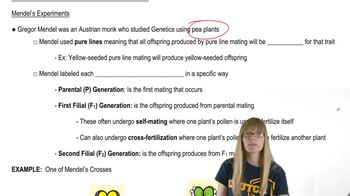
Mendel's Experiments

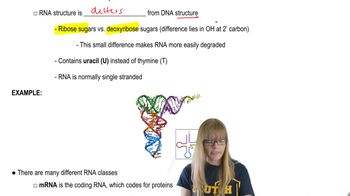
Distinction Between DNA and RNA

DNA and RNA are both nucleic acids but differ chemically; DNA contains deoxyribose sugar, while RNA contains ribose. The Hershey–Chase experiment did not differentiate between DNA and RNA because it only labeled DNA with phosphorus-32, assuming DNA was the nucleic acid present in phages, not considering RNA as genetic material.
추천 영상:

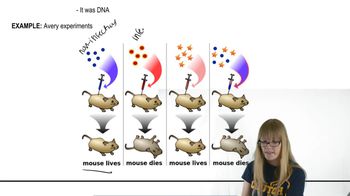
Identification of Genetic Material

The experiment demonstrated that DNA, not protein, entered bacterial cells and directed viral replication, supporting DNA as the genetic material. However, it did not explicitly rule out RNA because RNA was not labeled or tested, so the experiment distinguished DNA from protein but not DNA from RNA.
추천 영상:
가이드 코스
09:32
History and Experiments