Ch. 12 - DNA Organization in Chromosomes
Klug - Concepts of Genetics 12th Edition
Klug12th EditionConcepts of GeneticsISBN: 9780135564776당신이 사용하는 게 아니라요?교과서 변경
12장, 문제 15

Examples of histone modifications are acetylation (by histone acetyltransferase, or HAT), which is often linked to gene activation, and deacetylation (by histone deacetylases, or HDACs), which often leads to gene silencing typical of heterochromatin. Such heterochromatinization is initiated from a nucleation site and spreads bidirectionally until encountering boundaries that delimit the silenced areas. In the brief discussion of position effect, where repositioning of the w⁺ allele in Drosophila by translocation or inversion near heterochromatin produces intermittent w⁺ activity. In the heterozygous state (w⁺/w) a variegated eye is produced, with white and red patches. How might one explain position-effect variegation in terms of histone acetylation and/or deacetylation?

검증된 단계별 안내
1
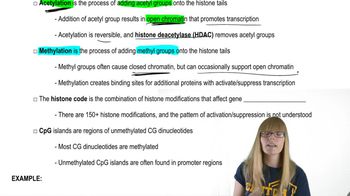
Understand the concept of histone modifications: Histone acetylation by histone acetyltransferase (HAT) is associated with gene activation, while histone deacetylation by histone deacetylases (HDACs) is linked to gene silencing. These modifications influence chromatin structure and gene expression.
Recall the concept of heterochromatinization: Heterochromatin spreads bidirectionally from a nucleation site until it encounters boundary elements. This spreading can silence genes located near heterochromatin regions.
Relate position-effect variegation (PEV) to chromatin structure: In Drosophila, the w⁺ allele's proximity to heterochromatin due to translocation or inversion results in intermittent gene activity. This leads to a variegated phenotype with red and white eye patches.
Consider the role of histone acetylation and deacetylation in PEV: Regions of heterochromatin are likely enriched in histone deacetylation, which silences gene expression. Conversely, areas of euchromatin with histone acetylation may allow gene activation, explaining the patchy expression of the w⁺ allele.
Propose a mechanism: The spreading of heterochromatin (via histone deacetylation) silences the w⁺ allele in some cells, while boundary elements or regions of euchromatin (via histone acetylation) prevent silencing in others, leading to the variegated phenotype observed in the heterozygous state.

비슷한 문제에 대한 검증된 영상 답변:

이 영상 해법은 위 문제에 도움이 된다고 튜터들이 추천한 것입니다.
영상 길이:
2m
도움이 되었나요?

주요 개념

질문에 올바르게 답하기 위해 반드시 이해해야 하는 핵심 개념들은 다음과 같습니다.

Histone Modifications

Histone modifications, such as acetylation and deacetylation, are chemical changes to histone proteins that influence gene expression. Acetylation, typically facilitated by histone acetyltransferases (HATs), is associated with gene activation by loosening DNA-histone interactions, allowing transcription factors access to DNA. Conversely, deacetylation, carried out by histone deacetylases (HDACs), often leads to gene silencing by tightening these interactions, promoting a more compact chromatin structure.
추천 영상:
가이드 코스
07:55
Histone Protein Modifications

Heterochromatin and Gene Silencing

Heterochromatin is a tightly packed form of DNA that is generally transcriptionally inactive, meaning genes located within heterochromatin are often silenced. This silencing is crucial for maintaining genomic stability and regulating gene expression. The formation of heterochromatin can be influenced by histone modifications, particularly deacetylation, which promotes a closed chromatin state, thereby preventing transcription of adjacent genes.
추천 영상:

Position Effect Variegation

Position effect variegation (PEV) occurs when the expression of a gene is influenced by its chromosomal location, particularly when it is relocated near heterochromatin. In Drosophila, the w⁺ allele can exhibit variable expression levels, resulting in a mosaic phenotype of red and white patches in the eyes. This phenomenon can be explained by the varying degrees of histone acetylation and deacetylation at the gene's new location, leading to inconsistent activation or silencing of the gene.
추천 영상:
가이드 코스
07:
Positional Cloning
관련 실천
교과서 질문

It has been shown that infectious agents such as viruses often exert a dramatic effect on their host cell's genome architecture. In many cases, viruses induce methylation of host DNA sequences in order to enhance their infectivity. What specific host gene functions would you consider as strong candidates for such methylation by infecting viruses?

571
views
교과서 질문

How many base pairs are in a molecule of phage T2 DNA 52-µm long?

838
views
교과서 질문

Assume that a viral DNA molecule is a 50-µm-long circular strand with a uniform 20-Å diameter. If this molecule is contained in a viral head that is a 0.08-µm-diameter sphere, will the DNA molecule fit into the viral head, assuming complete flexibility of the molecule? Justify your answer mathematically.

472
views
교과서 질문

Contrast the structure of SINE and LINE DNA sequences. Why are LINEs referred to as retrotransposons?

1075
views
교과서 질문

Mammals contain a diploid genome consisting of at least 10⁹ bp. If this amount of DNA is present as chromatin fibers, where each group of 200 bp of DNA is combined with 9 histones into a nucleosome and each group of 6 nucleosomes is combined into a solenoid, achieving a final packing ratio of 50, determine:

(a) the total number of nucleosomes in all fibers,

(b) the total number of histone molecules combined with DNA in the diploid genome, and

(c) the combined length of all fibers.

571
views
교과서 질문

Variable number tandem repeats (VNTRs) are repeating DNA sequences of about 15–100 bp in length, found both within and between genes. Why are they commonly used in forensics?

1050
views