Ch. 12 - DNA Organization in Chromosomes
Klug - Concepts of Genetics 12th Edition
Klug12th EditionConcepts of GeneticsISBN: 9780135564776당신이 사용하는 게 아니라요?교과서 변경
12장, 문제 17

Variable number tandem repeats (VNTRs) are repeating DNA sequences of about 15–100 bp in length, found both within and between genes. Why are they commonly used in forensics?

검증된 단계별 안내
1
VNTRs are highly polymorphic, meaning they vary greatly between individuals due to differences in the number of repeat units. This makes them useful for distinguishing between individuals in a population.
VNTRs are inherited from parents, allowing forensic scientists to use them for familial matching and paternity testing by comparing patterns of inheritance.
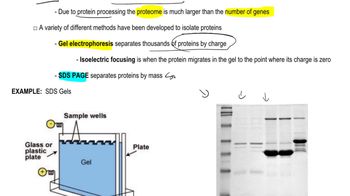
The length of VNTR regions can be analyzed using techniques such as gel electrophoresis or PCR (Polymerase Chain Reaction), which amplify and separate DNA fragments based on size.
VNTR patterns are unique to each individual (except identical twins), making them a reliable tool for creating DNA profiles in forensic investigations.
Because VNTRs are stable and do not change significantly over time, they can be used to analyze DNA samples from crime scenes, even if the samples are old or degraded.

비슷한 문제에 대한 검증된 영상 답변:

이 영상 해법은 위 문제에 도움이 된다고 튜터들이 추천한 것입니다.
영상 길이:
2m
도움이 되었나요?

주요 개념

질문에 올바르게 답하기 위해 반드시 이해해야 하는 핵심 개념들은 다음과 같습니다.

Variable Number Tandem Repeats (VNTRs)

VNTRs are short, repeating sequences of DNA that vary in number among individuals. These sequences can be found in non-coding regions of the genome and are highly polymorphic, meaning they differ significantly between people. This variability makes VNTRs useful for genetic profiling, as they can serve as unique identifiers for individuals.
추천 영상:

Forensic DNA Analysis

Forensic DNA analysis involves the examination of biological samples to identify individuals based on their unique genetic makeup. VNTRs are commonly used in this field because their high variability allows for the differentiation of DNA profiles, making it easier to match suspects to biological evidence found at crime scenes.
추천 영상:
가이드 코스
02:48
Chi Square Analysis

Genetic Profiling

Genetic profiling is a technique used to create a DNA profile for an individual, which can be compared against other profiles for identification purposes. By analyzing specific VNTR loci, forensic scientists can generate a unique genetic fingerprint that is statistically unlikely to match another individual, thus aiding in criminal investigations and paternity testing.
추천 영상:
가이드 코스
03:45
Descriptive Genetics
관련 실천
교과서 질문

It has been shown that infectious agents such as viruses often exert a dramatic effect on their host cell's genome architecture. In many cases, viruses induce methylation of host DNA sequences in order to enhance their infectivity. What specific host gene functions would you consider as strong candidates for such methylation by infecting viruses?

571
views
교과서 질문

How many base pairs are in a molecule of phage T2 DNA 52-µm long?

838
views
교과서 질문

Contrast the structure of SINE and LINE DNA sequences. Why are LINEs referred to as retrotransposons?

1075
views
교과서 질문

Examples of histone modifications are acetylation (by histone acetyltransferase, or HAT), which is often linked to gene activation, and deacetylation (by histone deacetylases, or HDACs), which often leads to gene silencing typical of heterochromatin. Such heterochromatinization is initiated from a nucleation site and spreads bidirectionally until encountering boundaries that delimit the silenced areas. In the brief discussion of position effect, where repositioning of the w⁺ allele in Drosophila by translocation or inversion near heterochromatin produces intermittent w⁺ activity. In the heterozygous state (w⁺/w) a variegated eye is produced, with white and red patches. How might one explain position-effect variegation in terms of histone acetylation and/or deacetylation?

935
views
교과서 질문

Cancer can be defined as an abnormal proliferation of cells that defy the normal regulatory controls observed by normal cells. Recently, histone deacetylation therapies have been attempted in the treatment of certain cancers [reviewed by Delcuve et al. (2009)]. Specifically, the FDA has approved histone deacetylation (HDAC) inhibitors for the treatment of cutaneous T-cell lymphoma. Explain why histone acetylation might be associated with cancer and what the rationale is for the use of HDAC inhibitors in the treatment of certain forms of cancer.

530
views
교과서 질문
In a study of Drosophila, two normally active genes, w⁺ (wild-type allele of the white-eye gene) and hsp26 (a heat-shock gene), were introduced (using a plasmid vector) into euchromatic and heterochromatic chromosomal regions, and the relative activity of each gene was assessed [Sun et al. (2002)]. An approximation of the resulting data is shown in the following table. Which characteristic or characteristics of heterochromatin are supported by the experimental data? Gene Activity (relative percentage) _ Euchromatin Heterochromatin hsp26 100% 31% w⁺ 100% 8%
515
views