Ch. 13 - The Genetic Code and Transcription
Klug - Concepts of Genetics 12th Edition
Klug12th EditionConcepts of GeneticsISBN: 9780135564776당신이 사용하는 게 아니라요?교과서 변경
13장, 문제 30b

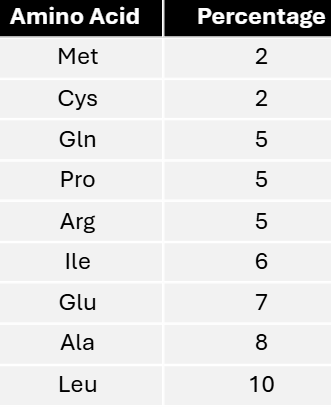
The genetic code is degenerate. Amino acids are encoded by either 1, 2, 3, 4, or 6 triplet codons. An interesting question is whether the number of triplet codes for a given amino acid is in any way correlated with the frequency with which that amino acid appears in proteins. That is, is the genetic code optimized for its intended use? Some approximations of the frequency of appearance of nine amino acids in proteins in E. coli are given in the following:

Devise a way to graphically compare the two sets of information (data).

검증된 단계별 안내
1
Step 1: Create a table that lists each amino acid alongside its corresponding percentage frequency and the number of triplet codons that encode it. This will help organize the data for comparison.
Step 2: Choose a graphical representation method, such as a bar graph or scatter plot. For a bar graph, use one axis (e.g., x-axis) to represent amino acids and the other axis (e.g., y-axis) to represent both frequency percentage and the number of codons. For a scatter plot, plot frequency percentage on one axis and the number of codons on the other axis.
Step 3: Assign different colors or markers to distinguish between the two datasets (frequency percentage and number of codons) in the graph. For example, use blue bars for frequency percentage and red bars for the number of codons in a bar graph.
Step 4: Label the axes clearly. For a bar graph, label the x-axis as 'Amino Acids' and the y-axis as 'Values'. For a scatter plot, label one axis as 'Frequency Percentage' and the other as 'Number of Codons'. Include a legend to explain the color or marker scheme.
Step 5: Analyze the graph to identify any patterns or correlations between the frequency of amino acids in proteins and the number of codons encoding them. For example, check if amino acids with higher frequency percentages tend to have more codons.

비슷한 문제에 대한 검증된 영상 답변:

이 영상 해법은 위 문제에 도움이 된다고 튜터들이 추천한 것입니다.
영상 길이:
2m
도움이 되었나요?

주요 개념

질문에 올바르게 답하기 위해 반드시 이해해야 하는 핵심 개념들은 다음과 같습니다.

Degeneracy of the Genetic Code

The genetic code is described as degenerate because multiple codons can encode the same amino acid. This redundancy allows for some mutations to occur without affecting the protein produced, which can be beneficial for evolutionary processes. Understanding this concept is crucial for analyzing how the frequency of amino acids relates to their codon usage.
추천 영상:
가이드 코스
11:43
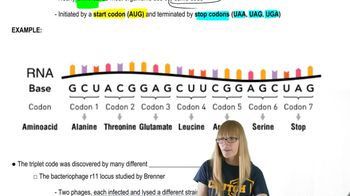
The Genetic Code

Amino Acid Frequency in Proteins

Amino acid frequency refers to how often specific amino acids appear in proteins, which can vary significantly among different organisms. In the context of E. coli, the provided percentages indicate the relative abundance of each amino acid in its proteins. This frequency can be correlated with the number of codons that encode each amino acid, providing insights into the optimization of the genetic code.
추천 영상:

Graphical Data Representation

Graphical data representation involves using visual formats, such as charts or graphs, to compare and analyze data sets effectively. In this case, a scatter plot or bar graph could be used to illustrate the relationship between the number of codons for each amino acid and their respective frequencies in E. coli proteins. This visual approach aids in identifying patterns and correlations in the data.
추천 영상:
가이드 코스
11:06
Mathematical Measurements
관련 실천
교과서 질문

M. Klemke et al. (2001) discovered an interesting coding phenomenon in which an exon within a neurologic hormone receptor gene in mammals appears to produce two different protein entities (and ALEX). The following is the DNA sequence of the exon's end derived from a rat.

  5'-gtcccaaccatgcccaccgatcttccgcctgcttctgaagATGCGGGCCCAG

The lowercase letters represent the initial coding portion for the protein, and the uppercase letters indicate the portion where the ALEX entity is initiated. (For simplicity, and to correspond with the RNA coding dictionary, it is customary to represent the coding (non-template) strand of the DNA segment.)

Convert the coding DNA sequence to the coding RNA sequence.

546
views
교과서 질문

Shown here are the amino acid sequences of the wild-type and three mutant forms of a short protein.

___________________________________________________

Wild-type: Met-Trp-Tyr-Arg-Gly-Ser-Pro-Thr

Mutant 1: Met-Trp

Mutant 2: Met-Trp-His-Arg-Gly-Ser-Pro-Thr

Mutant 3: Met -Cys-Ile-Val-Val-Val-Gln-His

___________________________________________________

Use this information to answer the following questions:

Another mutation (mutant 4) is isolated. Its amino acid sequence is unchanged from the wild type, but the mutant cells produce abnormally low amounts of the wild-type proteins. As specifically as you can, predict where this mutation exists in the gene.

1178
views
교과서 질문

Shown here are the amino acid sequences of the wild-type and three mutant forms of a short protein.

___________________________________________________

Wild-type: Met-Trp-Tyr-Arg-Gly-Ser-Pro-Thr

Mutant 1: Met-Trp

Mutant 2: Met-Trp-His-Arg-Gly-Ser-Pro-Thr

Mutant 3: Met-Cys-Ile-Val-Val-Val-Gln-Hi

___________________________________________________

Use this information to answer the following questions:

Of the first eight wild-type triplets, which, if any, can you determine specifically from an analysis of the mutant proteins? In each case, explain why or why not.

566
views
교과서 질문

The genetic code is degenerate. Amino acids are encoded by either 1, 2, 3, 4, or 6 triplet codons. An interesting question is whether the number of triplet codes for a given amino acid is in any way correlated with the frequency with which that amino acid appears in proteins. That is, is the genetic code optimized for its intended use? Some approximations of the frequency of appearance of nine amino acids in proteins in E. coli are given in the following:

Analyze your data to determine what, if any, correlations can be drawn between the relative frequency of amino acids making up proteins and the number of codons for each. Write a paragraph that states your specific and general conclusions.

713
views
교과서 질문

The genetic code is degenerate. Amino acids are encoded by either 1, 2, 3, 4, or 6 triplet codons. An interesting question is whether the number of triplet codes for a given amino acid is in any way correlated with the frequency with which that amino acid appears in proteins. That is, is the genetic code optimized for its intended use? Some approximations of the frequency of appearance of nine amino acids in proteins in E. coli are given in the following:

How would you proceed with your analysis if you wanted to pursue this problem further?

745
views
교과서 질문

The genetic code is degenerate. Amino acids are encoded by either 1, 2, 3, 4, or 6 triplet codons. An interesting question is whether the number of triplet codes for a given amino acid is in any way correlated with the frequency with which that amino acid appears in proteins. That is, is the genetic code optimized for its intended use? Some approximations of the frequency of appearance of nine amino acids in proteins in E. coli are given in the following:

Determine how many triplets encode each amino acid.

810
views