Ch. 14 - Translation and Proteins
Klug - Concepts of Genetics 12th Edition
Klug12th EditionConcepts of GeneticsISBN: 9780135564776당신이 사용하는 게 아니라요?교과서 변경
14장, 문제 21

Hemoglobins from two individuals are compared by electrophoresis and by fingerprinting. Electrophoresis reveals no difference in migration, but fingerprinting shows an amino acid difference. How is this possible?

검증된 단계별 안내
1
Understand that electrophoresis separates proteins based on their charge and size. If two hemoglobins migrate the same, they likely have similar overall charge and size.
Recognize that fingerprinting involves breaking down the protein into smaller peptide fragments and analyzing these fragments, often by chromatography or mass spectrometry.
Consider that a single amino acid change might not significantly alter the overall charge or size of the hemoglobin protein, thus not affecting its migration in electrophoresis.
Realize that fingerprinting is more sensitive to small changes, such as a single amino acid substitution, because it analyzes the specific sequence of peptides.
Conclude that the amino acid difference detected by fingerprinting could be a substitution that does not affect the charge or size of the protein enough to alter its electrophoretic mobility.

비슷한 문제에 대한 검증된 영상 답변:

이 영상 해법은 위 문제에 도움이 된다고 튜터들이 추천한 것입니다.
영상 길이:
2m
도움이 되었나요?

주요 개념

질문에 올바르게 답하기 위해 반드시 이해해야 하는 핵심 개념들은 다음과 같습니다.

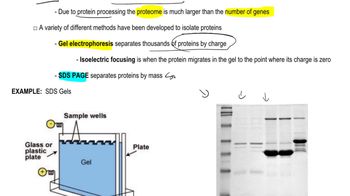
Electrophoresis

Electrophoresis is a laboratory technique used to separate macromolecules, such as proteins or nucleic acids, based on their size and charge. In the context of hemoglobins, this method allows for the visualization of protein variants by their migration through a gel under an electric field. If two hemoglobins migrate identically, it suggests that they have similar charge and size, indicating no detectable differences in their overall structure.
추천 영상:

Amino Acid Substitution

Amino acid substitution refers to a change in the protein sequence where one amino acid is replaced by another. This can occur due to mutations in the DNA that codes for the protein. While such substitutions may not affect the overall charge or size of the protein significantly enough to alter its migration in electrophoresis, they can still be detected through more sensitive methods like fingerprinting, which analyzes the specific sequence of amino acids.
추천 영상:
가이드 코스
09:49
Point Mutations

Protein Fingerprinting

Protein fingerprinting is a technique used to identify proteins based on their unique patterns of amino acids or peptide fragments. This method can reveal subtle differences between proteins that may not be apparent through electrophoresis. Fingerprinting can detect variations in amino acid composition or sequence, allowing for the identification of distinct protein variants even when they exhibit similar physical properties in other analyses.
추천 영상: