Ch. 14 - Translation and Proteins
Klug - Concepts of Genetics 12th Edition
Klug12th EditionConcepts of GeneticsISBN: 9780135564776당신이 사용하는 게 아니라요?교과서 변경
14장, 문제 32a

Three independently assorting genes (A, B, and C) are known to control the following biochemical pathway that provides the basis for flower color in a hypothetical plant:
Biochemical pathway showing gene A controls colorless to yellow, gene B yellow to green, and gene C green to speckled.
Three homozygous recessive mutations are also known, each of which interrupts a different one of these steps. Determine the phenotypic results in the F1 and F2 generations resulting from the P1 crosses of true-breeding plants listed here:
speckled (AABBCC) × yellow (AAbbCC)

검증된 단계별 안내
1
Step 1: Identify the genotypes of the parent plants and their phenotypes based on the biochemical pathway. The speckled parent has genotype AABBCC, meaning all dominant alleles are present, so the pathway proceeds fully to speckled. The yellow parent has genotype AAbbCC, meaning it is homozygous recessive for gene B, which interrupts the step from yellow to green, so the phenotype is yellow.
Step 2: Determine the genotype of the F1 generation by crossing the two parents. Since the speckled parent is AABBCC and the yellow parent is AAbbCC, the F1 offspring will inherit one allele from each parent for each gene, resulting in genotype AABbCC.
Step 3: Predict the phenotype of the F1 generation based on their genotype. Since gene B is heterozygous (Bb) and gene B controls the step from yellow to green, and assuming B is dominant, the pathway proceeds from colorless to yellow to green, but not to speckled because gene C is homozygous dominant (CC). Therefore, the F1 phenotype will be green.
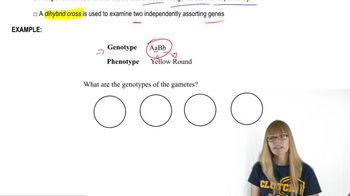
Step 4: Determine the possible gametes produced by the F1 individuals for the F2 generation. Since the F1 genotype is AABbCC, the gametes will be AB C and AB c, but since gene A and C are homozygous dominant, only gene B will segregate, producing gametes with B or b alleles.
Step 5: Use a Punnett square to predict the genotypic and phenotypic ratios of the F2 generation by crossing F1 individuals (AABbCC × AABbCC). Analyze the combinations of B alleles (BB, Bb, bb) to determine the phenotypes: BB and Bb will allow the pathway to proceed to green or speckled, while bb will interrupt the pathway at yellow. Then, consider gene C to determine if the final color is green or speckled.

비슷한 문제에 대한 검증된 영상 답변:

이 영상 해법은 위 문제에 도움이 된다고 튜터들이 추천한 것입니다.
영상 길이:
3m
도움이 되었나요?

주요 개념

질문에 올바르게 답하기 위해 반드시 이해해야 하는 핵심 개념들은 다음과 같습니다.

Independent Assortment of Genes

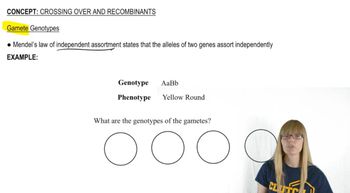
Independent assortment refers to the principle that genes located on different chromosomes are inherited independently of each other. In this question, genes A, B, and C assort independently, meaning the alleles for each gene segregate without influencing the others, which affects the genotypic and phenotypic ratios in offspring.
추천 영상:
가이드 코스
04:58
Gamete Genetics and Independent Assortment

Biochemical Pathways and Gene Function

The biochemical pathway shows a sequential conversion of colorless to speckled via yellow and green, controlled by genes A, B, and C respectively. Each gene's functional allele enables a step in the pathway, while recessive mutations block that step, resulting in accumulation of the previous color and affecting the phenotype.
추천 영상:
가이드 코스
08:26
Functional Genomics

Genotypic and Phenotypic Ratios in Crosses

Understanding how to predict F1 and F2 generation phenotypes requires knowledge of Mendelian genetics, including how homozygous and heterozygous genotypes combine. The cross between speckled (AABBCC) and yellow (AAbbCC) plants will produce specific genotypic combinations that determine the flower color phenotypes in subsequent generations.
추천 영상:
가이드 코스
07:52
Gamete Genotypes
관련 실천
교과서 질문

How does an enzyme function? Why are enzymes essential for living organisms on Earth?

720
views
교과서 질문

How would the results vary in cross (a) of Problem 32 if genes A and B were linked with no crossing over between them? How would the results of cross (a) vary if genes A and B were linked and 20 map units (mu) apart?

760
views
교과서 질문

Why are misfolded proteins a potential problem for the eukaryotic cell, and how do cells combat the accumulation of misfolded proteins?

637
views
교과서 질문

Exon shuffling is a proposal that relates exons in DNA to the repositioning of functional domains in proteins. What evidence exists in support of exon shuffling?

905
views
교과서 질문

Three independently assorting genes (A, B, and C) are known to control the following biochemical pathway that provides the basis for flower color in a hypothetical plant:

Three homozygous recessive mutations are also known, each of which interrupts a different one of these steps. Determine the phenotypic results in the F1 and F2 generations resulting from the P1 crosses of true-breeding plants listed here:

colorless (aaBBCC) × green (AABBcc)

678
views
교과서 질문

Three independently assorting genes (A, B, and C) are known to control the following biochemical pathway that provides the basis for flower color in a hypothetical plant:

Three homozygous recessive mutations are also known, each of which interrupts a different one of these steps. Determine the phenotypic results in the F1 and F2 generations resulting from the P1 crosses of true-breeding plants listed here:

yellow (AAbbCC) × green (AABBcc)

531
views