Ch. 17 - Transcriptional Regulation in Eukaryotes
Klug - Concepts of Genetics 12th Edition
Klug12th EditionConcepts of GeneticsISBN: 9780135564776당신이 사용하는 게 아니라요?교과서 변경
17장, 문제 7

Provide a brief description of two different types of histone modification and how they impact transcription.

검증된 단계별 안내
1
Step 1: Understand that histone modifications are chemical changes to the histone proteins around which DNA is wrapped, affecting how tightly or loosely DNA is packaged and thus influencing gene expression.
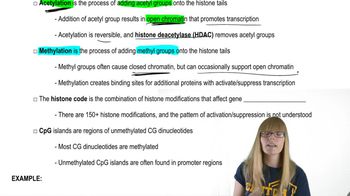
Step 2: Describe acetylation, a type of histone modification where an acetyl group is added to lysine residues on histone tails. This reduces the positive charge on histones, decreasing their affinity for negatively charged DNA, leading to a more relaxed chromatin structure and generally promoting transcription.
Step 3: Describe methylation, another histone modification where methyl groups are added to lysine or arginine residues on histones. Depending on the specific site and degree of methylation, this can either activate or repress transcription by altering chromatin structure or recruiting regulatory proteins.
Step 4: Explain that acetylation is typically associated with transcriptional activation because it opens up chromatin, making DNA more accessible to transcription factors and RNA polymerase.
Step 5: Explain that methylation can have dual effects: for example, trimethylation of histone H3 at lysine 4 (H3K4me3) is linked to active transcription, while trimethylation at lysine 9 (H3K9me3) is associated with transcriptional repression and heterochromatin formation.

비슷한 문제에 대한 검증된 영상 답변:

이 영상 해법은 위 문제에 도움이 된다고 튜터들이 추천한 것입니다.
영상 길이:
28s
도움이 되었나요?

주요 개념

질문에 올바르게 답하기 위해 반드시 이해해야 하는 핵심 개념들은 다음과 같습니다.

Histone Modification

Histone modifications are chemical changes to the histone proteins around which DNA is wrapped. These modifications, such as methylation or acetylation, alter chromatin structure and influence gene accessibility, thereby regulating transcriptional activity.
추천 영상:
가이드 코스
07:55
Histone Protein Modifications

Histone Acetylation

Histone acetylation involves adding acetyl groups to lysine residues on histone tails, which neutralizes positive charges and reduces histone-DNA interaction. This leads to a more relaxed chromatin structure, promoting transcription by allowing transcription factors easier access to DNA.
추천 영상:
가이드 코스
07:55
Histone Protein Modifications

Histone Methylation

Histone methylation adds methyl groups to specific lysine or arginine residues on histones. Depending on the site and degree of methylation, it can either activate or repress transcription by recruiting proteins that modify chromatin structure or interact with the transcription machinery.
추천 영상:
가이드 코스
07:55
Histone Protein Modifications