Ch. 21 - Genomic Analysis
Klug - Concepts of Genetics  12th Edition
Klug12th EditionConcepts of Genetics ISBN: 9780135564776당신이 사용하는 게 아니라요?교과서 변경
21장, 문제 14

Explain differences between whole-genome sequencing (WGS) and whole-exome sequencing (WES), and describe advantages and disadvantages of each approach for identifying disease-causing mutations in a genome. Which approach was used for the Human Genome Project?

검증된 단계별 안내
1
Start by defining Whole-Genome Sequencing (WGS) as the process of determining the complete DNA sequence of an organism's genome at a single time, which includes both coding (exons) and non-coding regions (introns, regulatory sequences, intergenic regions).
Define Whole-Exome Sequencing (WES) as a targeted sequencing approach that focuses only on the exons, the protein-coding regions of the genome, which represent about 1-2% of the entire genome but contain a high proportion of known disease-causing mutations.
Compare the advantages of WGS: it provides a comprehensive view of the entire genome, allowing detection of mutations in coding and non-coding regions, structural variants, and regulatory elements. However, it is more expensive and generates a larger amount of data that requires more complex analysis.
Compare the advantages of WES: it is more cost-effective and faster than WGS, focusing on regions most likely to contain disease-causing mutations, which simplifies data analysis. The disadvantage is that it misses mutations outside the exons, such as those in regulatory or intronic regions that can also affect gene function.
Explain that the Human Genome Project primarily used a whole-genome sequencing approach to map the entire human genome, as its goal was to obtain a complete reference sequence rather than focusing only on coding regions.

비슷한 문제에 대한 검증된 영상 답변:

이 영상 해법은 위 문제에 도움이 된다고 튜터들이 추천한 것입니다.
영상 길이:
1m
도움이 되었나요?

주요 개념

질문에 올바르게 답하기 위해 반드시 이해해야 하는 핵심 개념들은 다음과 같습니다.

Whole-Genome Sequencing (WGS)

WGS involves sequencing the entire DNA content of an organism's genome, including coding and non-coding regions. It provides a comprehensive view of all genetic variations, enabling detection of mutations anywhere in the genome. WGS is useful for discovering novel variants but is more expensive and generates large data sets requiring extensive analysis.
추천 영상:
가이드 코스
08:55
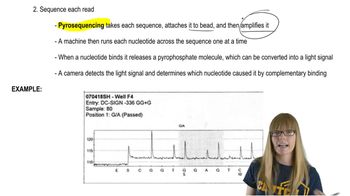
Sequencing Overview

Whole-Exome Sequencing (WES)

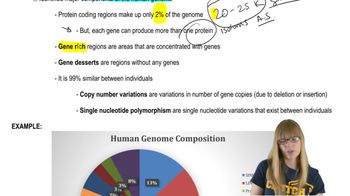
WES targets only the exons, the protein-coding regions of the genome, which represent about 1-2% of the genome but harbor most known disease-causing mutations. It is more cost-effective and faster than WGS, focusing on regions most likely to affect protein function. However, it misses mutations in non-coding or regulatory regions.
추천 영상:
가이드 코스
08:55
Sequencing Overview

Human Genome Project Sequencing Approach

The Human Genome Project primarily used whole-genome sequencing to map the entire human genome. This approach allowed comprehensive identification of all genetic elements, including coding and non-coding regions, providing a foundational reference for human genetics. The project’s scale and technology at the time made WGS the suitable choice.
추천 영상:
가이드 코스
06:51
Human Genome Composition