Ch. 21 - Genomic Analysis
Klug - Concepts of Genetics 12th Edition
Klug12th EditionConcepts of GeneticsISBN: 9780135564776당신이 사용하는 게 아니라요?교과서 변경
21장, 문제 12

The Human Genome Project has demonstrated that in humans of all races and nationalities approximately 99.9 percent of the genome sequence is the same, yet different individuals can be identified by DNA fingerprinting techniques. What is one primary variation in the human genome that can be used to distinguish different individuals? Briefly explain your answer.

검증된 단계별 안내
1
Understand that although the human genome is about 99.9% identical across all individuals, the small 0.1% variation is what allows us to distinguish between people genetically.
Identify the main type of genetic variation used in DNA fingerprinting: these are called Short Tandem Repeats (STRs) or Variable Number Tandem Repeats (VNTRs), which are sequences of DNA where a short sequence of bases is repeated multiple times in a row.
Explain that the number of repeats at these STR or VNTR loci varies greatly among individuals, making these regions highly polymorphic and useful for identification.
Note that DNA fingerprinting analyzes multiple STR loci across the genome to create a unique genetic profile for each individual, since the combination of repeat numbers at different loci is highly unlikely to be the same in two unrelated people.
Summarize that the primary variation used to distinguish individuals in DNA fingerprinting is the difference in the number of tandem repeats at specific loci in the genome.

비슷한 문제에 대한 검증된 영상 답변:

이 영상 해법은 위 문제에 도움이 된다고 튜터들이 추천한 것입니다.
영상 길이:
1m

주요 개념

질문에 올바르게 답하기 위해 반드시 이해해야 하는 핵심 개념들은 다음과 같습니다.

Human Genome Similarity

The human genome is remarkably similar across all individuals, with about 99.9% of the DNA sequence being identical. This high similarity reflects shared genetic heritage and common biological functions, but the small differences account for individual uniqueness.
추천 영상:
가이드 코스
06:51
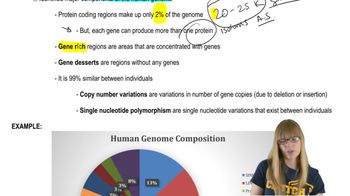
Human Genome Composition

Genetic Variation and Polymorphisms

Genetic variation refers to differences in DNA sequences among individuals. Polymorphisms, such as single nucleotide polymorphisms (SNPs) and variable number tandem repeats (VNTRs), are common types of variations that contribute to genetic diversity and can be used to distinguish individuals.
추천 영상:
가이드 코스
09:28
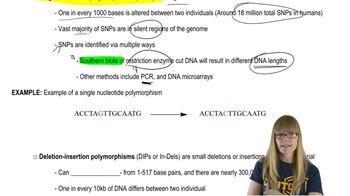
Genomic Variation

DNA Fingerprinting and Short Tandem Repeats (STRs)

DNA fingerprinting uses specific regions of the genome called short tandem repeats (STRs), which are repeating sequences that vary in length between individuals. These variations in STR patterns provide a unique genetic profile for each person, enabling identification despite overall genome similarity.
추천 영상:
가이드 코스
09:28
Genomic Variation