Ch. 22 - Applications of Genetic Engineering and Biotechnology
Klug - Concepts of Genetics 12th Edition
Klug12th EditionConcepts of GeneticsISBN: 9780135564776당신이 사용하는 게 아니라요?교과서 변경
22장, 문제 13

Describe how the team from the J. Craig Venter Institute created a synthetic genome. How did the team demonstrate that the genome converted the recipient strain of bacteria into a different strain?

검증된 단계별 안내
1
Understand that the J. Craig Venter Institute team aimed to create a synthetic genome by chemically synthesizing the entire DNA sequence of a bacterial genome from scratch, rather than copying it from an existing organism.
Recognize that the team first determined the complete DNA sequence of the target bacterium (Mycoplasma mycoides) and then used automated DNA synthesis techniques to build small fragments of DNA, which were subsequently assembled into larger segments through a series of molecular cloning steps.
Note that these larger DNA segments were progressively combined using yeast cells as a host for assembly, ultimately resulting in a full-length synthetic genome that matched the natural genome sequence but was chemically synthesized.
Understand that to demonstrate functionality, the synthetic genome was transplanted into a recipient bacterial cell (Mycoplasma capricolum) whose own DNA had been removed or inactivated, effectively replacing its genome with the synthetic one.
Observe that the recipient cells began to exhibit the characteristics and behaviors of the donor species (Mycoplasma mycoides), proving that the synthetic genome was capable of directing cellular functions and converting the recipient strain into a new strain.

비슷한 문제에 대한 검증된 영상 답변:

이 영상 해법은 위 문제에 도움이 된다고 튜터들이 추천한 것입니다.
영상 길이:
2m

주요 개념

질문에 올바르게 답하기 위해 반드시 이해해야 하는 핵심 개념들은 다음과 같습니다.

Synthetic Genome Construction

Synthetic genome construction involves chemically synthesizing DNA sequences in the laboratory to create an entire genome from scratch. The Venter Institute team assembled short DNA fragments into larger segments, eventually building a complete bacterial genome. This process requires precise sequencing and assembly techniques to ensure the synthetic genome matches the natural one.
추천 영상:
가이드 코스
02:48
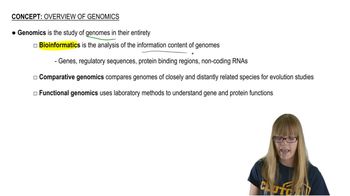
Genomics Overview

Genome Transplantation

Genome transplantation is the process of inserting a synthetic genome into a recipient cell whose original DNA has been removed or inactivated. The Venter team transplanted their synthetic genome into a bacterial cell, effectively replacing its native genome. This step is crucial to test whether the synthetic genome can control the cell's functions and replication.
추천 영상:
가이드 코스
02:48
Genomics Overview

Phenotypic Conversion as Evidence of Genome Function

Phenotypic conversion refers to the change in observable traits of the recipient bacteria after receiving the synthetic genome. The Venter team demonstrated that the recipient strain adopted the characteristics of the donor genome, such as colony appearance and growth behavior, proving that the synthetic genome was functional and directed the cell's biology.
추천 영상:
가이드 코스
08:26
Functional Genomics
관련 실천
교과서 질문

Does genetic analysis by ASO testing allow for detection of epigenetic changes that may contribute to a genetic disorder? Explain your answer.

508
views
교과서 질문

Dominant mutations can be categorized according to whether they increase or decrease the overall activity of a gene or gene product. Although a loss-of-function mutation (a mutation that inactivates the gene product) is usually recessive, for some genes, one dose of the normal gene product, encoded by the normal allele, is not sufficient to produce a normal phenotype. In this case, a loss-of-function mutation in the gene will be dominant, and the gene is said to be haploinsufficient. A second category of dominant mutation is the gain-of-function mutation, which results in a new activity or increased activity or expression of a gene or gene product. The gene therapy technique currently being used in clinical trials involves the 'addition' to somatic cells of a normal copy of a gene. In other words, a normal copy of the gene is inserted into the genome of the mutant somatic cell, but the mutated copy of the gene is not removed or replaced. Will this strategy work for either of the two aforementioned types of dominant mutations?

670
views
교과서 질문

The family of a sixth-grade boy in Palo Alto, California, was informed by school administrators that he would have to transfer out of his middle school because they believed his mutation of the CFTR gene, which does not produce any symptoms associated with cystic fibrosis, posed a risk to other students at the school who have cystic fibrosis. After missing 11 days of school, a settlement was reached to have the boy return to school. What ethical problems might you associate with this example?

502
views
교과서 질문

Consider ethical issues associated with creating a synthetic human genome. Are there specific applications for a synthetic human genome that you support? Is creating a synthetic genome enhanced with genes for certain kinds of traits one of those applications?

523
views
교과서 질문

What is the main purpose of genome-wide association studies (GWAS)? How can information from GWAS be used to inform scientists and physicians about genetic diseases?

1031
views
1
rank
교과서 질문

Maternal blood tests for three pregnant women revealed they would be having boys, yet subsequent ultrasound images showed all three were pregnant with girls. In each case Y chromosome sequences in each mother's blood originated from transplanted organs they had received from men! This demonstrates one dramatic example of a limitation of genetic analysis of maternal blood samples. What kind of information could have been collected from each mother in advance of these tests to better inform physicians prior to performing each test?

477
views