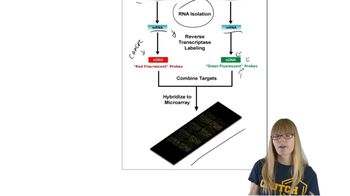
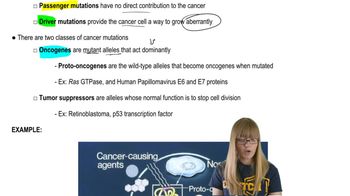
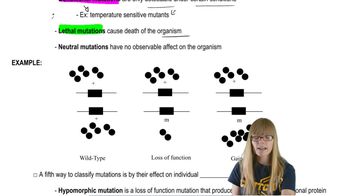
DNA sequencing has provided data to indicate that cancer cells may contain tens of thousands of somatic mutations, only some of which confer a growth advantage to a cancer cell. How do scientists describe and categorize these recently discovered populations of mutations in cancer cells?
Ch. 24 - Cancer Genetics

24장, 문제 14
Of the two classes of genes associated with cancer, tumor-suppressor genes and oncogenes, mutations in which group can be considered gain-of-function mutations? In which group are the loss-of-function mutations? Explain.
검증된 단계별 안내1
Understand the two classes of genes associated with cancer: tumor-suppressor genes and oncogenes. Tumor-suppressor genes normally act to inhibit cell division or promote apoptosis, preventing uncontrolled cell growth. Oncogenes, on the other hand, promote cell division and survival when activated.
Recall the definitions of gain-of-function and loss-of-function mutations. Gain-of-function mutations result in a gene product with enhanced or new activity, while loss-of-function mutations reduce or eliminate the normal activity of the gene product.
Analyze oncogenes: mutations in oncogenes typically lead to gain-of-function, meaning the mutated gene is overactive or constitutively active, driving excessive cell proliferation. This is because oncogenes are like the 'gas pedal' for cell growth.
Analyze tumor-suppressor genes: mutations here are usually loss-of-function, meaning the gene loses its ability to regulate or inhibit cell growth. This loss removes the 'brakes' on cell division, allowing uncontrolled growth.
Summarize that gain-of-function mutations are characteristic of oncogenes, while loss-of-function mutations are characteristic of tumor-suppressor genes, explaining their roles in cancer development.

비슷한 문제에 대한 검증된 영상 답변:
이 영상 해법은 위 문제에 도움이 된다고 튜터들이 추천한 것입니다.
영상 길이:
2m주요 개념
질문에 올바르게 답하기 위해 반드시 이해해야 하는 핵심 개념들은 다음과 같습니다.
Oncogenes and Gain-of-Function Mutations
Oncogenes are mutated forms of proto-oncogenes that promote cell growth and division. Gain-of-function mutations in these genes lead to their overactivation or constant activity, driving uncontrolled cell proliferation and contributing to cancer development.
추천 영상:
가이드 코스
Functional Genomics
Tumor-Suppressor Genes and Loss-of-Function Mutations
Tumor-suppressor genes normally inhibit cell growth or promote apoptosis to prevent tumor formation. Loss-of-function mutations in these genes disable their protective roles, allowing cells to grow unchecked and increasing cancer risk.
추천 영상:
가이드 코스
Cancer Mutations
Difference Between Gain- and Loss-of-Function Mutations
Gain-of-function mutations enhance or create new gene activity, often dominant in oncogenes, while loss-of-function mutations reduce or eliminate gene activity, typically recessive in tumor-suppressor genes. Understanding this distinction is key to grasping how different gene classes contribute to cancer.
추천 영상:
가이드 코스
Mutations and Phenotypes
관련 실천
교과서 질문
725
views
교과서 질문
How do translocations such as the Philadelphia chromosome contribute to cancer?
772
views
교과서 질문
If a cell suffers damage to its DNA while in S phase, how can this damage be repaired before the cell enters mitosis?
558
views
교과서 질문
Distinguish between oncogenes and proto-oncogenes. In what ways can proto-oncogenes be converted to oncogenes?
894
views
교과서 질문
Explain why many oncogenic viruses contain genes whose products interact with tumor-suppressor proteins.
722
views
교과서 질문
Part of the Ras protein is associated with the plasma membrane, and part extends into the cytoplasm. How does the Ras protein transmit a signal from outside the cell into the cytoplasm? What happens in cases where the ras gene is mutated?
518
views
