Ch. 24 - Cancer Genetics
Klug - Concepts of Genetics 12th Edition
Klug12th EditionConcepts of GeneticsISBN: 9780135564776당신이 사용하는 게 아니라요?교과서 변경
24장, 문제 17

DNA sequencing has provided data to indicate that cancer cells may contain tens of thousands of somatic mutations, only some of which confer a growth advantage to a cancer cell. How do scientists describe and categorize these recently discovered populations of mutations in cancer cells?

검증된 단계별 안내
1
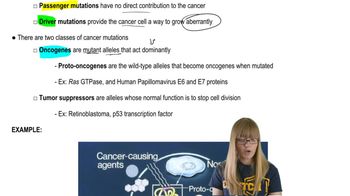
span>Understand the types of mutations: In cancer cells, mutations can be categorized into 'driver' mutations, which contribute to cancer progression, and 'passenger' mutations, which do not confer a growth advantage.
span>Identify driver mutations: Scientists use various methods, such as statistical analyses and functional assays, to identify which mutations are likely to be driver mutations.
span>Characterize passenger mutations: These are mutations that accumulate in cancer cells but do not directly contribute to cancer growth. They are often used as markers to study the history and evolution of cancer cells.
span>Use sequencing data: High-throughput DNA sequencing technologies allow scientists to sequence the entire genome of cancer cells, providing a comprehensive view of all mutations present.
span>Apply bioinformatics tools: Scientists use computational tools to analyze sequencing data, distinguishing between driver and passenger mutations based on their frequency, location, and impact on protein function.

비슷한 문제에 대한 검증된 영상 답변:

이 영상 해법은 위 문제에 도움이 된다고 튜터들이 추천한 것입니다.
영상 길이:
47s
도움이 되었나요?

주요 개념

질문에 올바르게 답하기 위해 반드시 이해해야 하는 핵심 개념들은 다음과 같습니다.

Somatic Mutations

Somatic mutations are genetic alterations that occur in non-germline cells, meaning they are not inherited but arise during an individual's lifetime. These mutations can result from environmental factors, errors in DNA replication, or other cellular processes. In cancer, somatic mutations can accumulate and contribute to tumorigenesis by altering cell behavior, such as promoting uncontrolled growth.
추천 영상:
가이드 코스
09:49
Point Mutations

Tumor Heterogeneity

Tumor heterogeneity refers to the presence of diverse cell populations within a single tumor, which can differ genetically and phenotypically. This diversity arises from the accumulation of somatic mutations and can lead to variations in how cancer cells respond to treatment. Understanding tumor heterogeneity is crucial for developing effective therapies, as some mutations may confer resistance to specific drugs.
추천 영상:
가이드 코스
09:46
Cancer Characteristics

Oncogenic Mutations

Oncogenic mutations are specific genetic changes that promote cancer development by enhancing cell proliferation or survival. These mutations often affect genes involved in critical pathways, such as those regulating cell cycle, apoptosis, and signal transduction. Scientists categorize mutations based on their functional impact, distinguishing between driver mutations, which contribute to cancer progression, and passenger mutations, which do not affect tumor growth.
추천 영상:
가이드 코스
04:46
Cancer Mutations