Ch. 25 - Quantitative Genetics and Multifactorial Traits
Klug - Concepts of Genetics 12th Edition
Klug12th EditionConcepts of GeneticsISBN: 9780135564776당신이 사용하는 게 아니라요?교과서 변경
25장, 문제 4c

A dark-red strain and a white strain of wheat are crossed and produce an intermediate, medium-red F₁. When the F₁ plants are interbred, an F₂ generation is produced in a ratio of 1 dark-red: 4 medium-dark-red: 6 medium-red: 4 light-red: 1 white. Further crosses reveal that the dark-red and white F₂ plants are true breeding
Assign symbols to these alleles, and list possible genotypes that give rise to the medium-red and light-red phenotypes.

검증된 단계별 안내
1
Step 1: Recognize that the inheritance pattern described is an example of incomplete dominance, where the heterozygote shows an intermediate phenotype between the two homozygotes. The parental strains are dark-red and white, and the F₁ is medium-red, an intermediate color.
Step 2: Assign allele symbols to the two alleles involved. For example, let \( R_d \) represent the dark-red allele and \( R_w \) represent the white allele. Since the F₁ is intermediate, the heterozygote \( R_d R_w \) shows medium-red color.
Step 3: Analyze the F₂ phenotypic ratio: 1 dark-red : 4 medium-dark-red : 6 medium-red : 4 light-red : 1 white. This suggests multiple genotypic classes with varying dosages of the alleles, indicating that the trait is controlled by more than one allele or by gene dosage effects.
Step 4: Propose genotypes for each phenotype based on allele dosage. The homozygotes \( R_d R_d \) and \( R_w R_w \) correspond to dark-red and white, respectively (true breeding). The intermediate phenotypes (medium-dark-red, medium-red, light-red) likely correspond to heterozygotes with different combinations or dosages of the alleles, such as \( R_d R_w \), \( R_d R_d R_w \), or \( R_d R_w R_w \) if multiple alleles or gene copies are involved.
Step 5: Specifically list possible genotypes for medium-red and light-red phenotypes. For example, medium-red could be the simple heterozygote \( R_d R_w \), while light-red could be a genotype with more white allele dosage, such as \( R_d R_w R_w \) or a similar combination depending on the genetic model.

비슷한 문제에 대한 검증된 영상 답변:

이 영상 해법은 위 문제에 도움이 된다고 튜터들이 추천한 것입니다.
영상 길이:
2m
도움이 되었나요?

주요 개념

질문에 올바르게 답하기 위해 반드시 이해해야 하는 핵심 개념들은 다음과 같습니다.

Incomplete Dominance

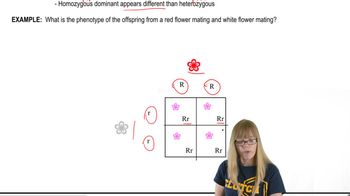
Incomplete dominance occurs when heterozygous individuals display a phenotype intermediate between the two homozygous parents. In this wheat example, the F₁ medium-red color results from blending of dark-red and white alleles, rather than one being completely dominant over the other.
추천 영상:
가이드 코스
04:37
Variations on Dominance

Genotype-Phenotype Relationship and Allele Symbol Assignment

Assigning symbols to alleles helps track inheritance patterns. Typically, the darkest phenotype is assigned the dominant allele (e.g., R), the lightest the recessive (e.g., r), and intermediate phenotypes arise from heterozygous or multiple allele combinations. Understanding which genotypes correspond to each phenotype is key.
추천 영상:
가이드 코스
07:55
Non-Random Mating

F₂ Phenotypic Ratios and True Breeding

The F₂ generation's phenotypic ratio reflects the segregation and combination of alleles. True breeding plants (dark-red and white) are homozygous, confirming allele assignments. The complex 1:4:6:4:1 ratio suggests multiple allele interactions or codominance, requiring analysis of genotype combinations for intermediate phenotypes.
추천 영상:
가이드 코스
08:06
Mendel's Experiments
관련 실천
교과서 질문

Define the following:

(a) Polygenic

(b) Additive alleles

(c) Correlation

(d) Monozygotic and dizygotic twins

(e) Heritability

(f) QTL

(g) Continuous variation

625
views
교과서 질문

Height in humans depends on the additive action of genes. Assume that this trait is controlled by the four loci R, S, T, and U and that environmental effects are negligible. Instead of additive versus nonadditive alleles, assume that additive and partially additive alleles exist. Additive alleles contribute two units, and partially additive alleles contribute one unit to height.

If an individual with the minimum height specified by these genes marries an individual of intermediate or moderate height, will any of their children be taller than the tall parent? Why or why not?

699
views
교과서 질문

A dark-red strain and a white strain of wheat are crossed and produce an intermediate, medium-red F₁. When the F₁ plants are interbred, an F₂ generation is produced in a ratio of 1 dark-red: 4 medium-dark-red: 6 medium-red: 4 light-red: 1 white. Further crosses reveal that the dark-red and white F₂ plants are true breeding

Predict the outcome of the F1 and F2 generations in a cross between a true-breeding medium-red plant and a white plant.

722
views
교과서 질문

A dark-red strain and a white strain of wheat are crossed and produce an intermediate, medium-red F₁. When the F₁ plants are interbred, an F₂ generation is produced in a ratio of 1 dark-red: 4 medium-dark-red: 6 medium-red: 4 light-red: 1 white. Further crosses reveal that the dark-red and white F₂ plants are true breeding

Based on the ratios in the F₂ population, how many genes are involved in the production of color?

464
views
교과서 질문

Height in humans depends on the additive action of genes. Assume that this trait is controlled by the four loci R, S, T, and U and that environmental effects are negligible. Instead of additive versus nonadditive alleles, assume that additive and partially additive alleles exist. Additive alleles contribute two units, and partially additive alleles contribute one unit to height.

Can two individuals of moderate height produce offspring that are much taller or shorter than either parent? If so, how?

915
views
교과서 질문

A dark-red strain and a white strain of wheat are crossed and produce an intermediate, medium-red F₁. When the F₁ plants are interbred, an F₂ generation is produced in a ratio of 1 dark-red: 4 medium-dark-red: 6 medium-red: 4 light-red: 1 white. Further crosses reveal that the dark-red and white F₂ plants are true breeding

How many additive alleles are needed to produce each possible phenotype?

438
views