Ch. 25 - Quantitative Genetics and Multifactorial Traits
Klug - Concepts of Genetics 12th Edition
Klug12th EditionConcepts of GeneticsISBN: 9780135564776당신이 사용하는 게 아니라요?교과서 변경
25장, 문제 4a

A dark-red strain and a white strain of wheat are crossed and produce an intermediate, medium-red F₁. When the F₁ plants are interbred, an F₂ generation is produced in a ratio of 1 dark-red: 4 medium-dark-red: 6 medium-red: 4 light-red: 1 white. Further crosses reveal that the dark-red and white F₂ plants are true breeding
Based on the ratios in the F₂ population, how many genes are involved in the production of color?

검증된 단계별 안내
1
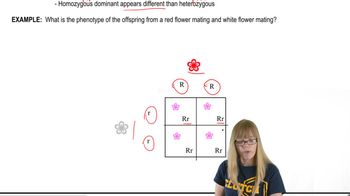
Recognize that the F₁ generation shows an intermediate phenotype (medium-red) between the two parental strains (dark-red and white), which suggests incomplete dominance or additive gene action rather than simple dominance.
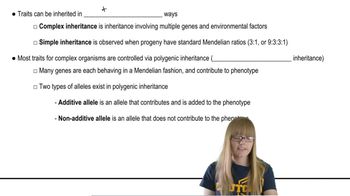
Examine the F₂ phenotypic ratio given: 1 dark-red : 4 medium-dark-red : 6 medium-red : 4 light-red : 1 white. Notice that this ratio resembles the expansion of a binomial expression raised to the fourth power, which hints at multiple genes contributing additively to the trait.
Recall that when multiple genes contribute additively to a trait, the F₂ phenotypic ratios often follow the pattern of the coefficients in the expansion of \((a + b)^n\), where \(n\) is the number of genes involved. The coefficients for \((a + b)^4\) are 1, 4, 6, 4, 1, matching the observed ratio.
Conclude that the number of genes involved corresponds to the exponent \(n\) in the binomial expansion that fits the observed ratio. Here, since the ratio matches the coefficients of \((a + b)^4\), it suggests that 4 genes are involved in producing the color.
Confirm this conclusion by considering that the dark-red and white F₂ plants are true breeding, indicating homozygosity at all loci, which aligns with the idea of multiple additive genes segregating independently.

비슷한 문제에 대한 검증된 영상 답변:

이 영상 해법은 위 문제에 도움이 된다고 튜터들이 추천한 것입니다.
영상 길이:
2m

주요 개념

질문에 올바르게 답하기 위해 반드시 이해해야 하는 핵심 개념들은 다음과 같습니다.

Incomplete Dominance and Intermediate Phenotypes

Incomplete dominance occurs when heterozygous individuals display a phenotype intermediate between the two homozygous parents. In this question, the F₁ generation shows a medium-red color, which is between dark-red and white, indicating that neither allele is completely dominant. This concept helps explain the blending of traits seen in the offspring.
추천 영상:
가이드 코스
04:37
Variations on Dominance

Polygenic Inheritance and Quantitative Trait Ratios

Polygenic inheritance involves multiple genes contributing additively to a single trait, producing a range of phenotypes. The complex F₂ ratio (1:4:6:4:1) suggests several genes influence wheat color, with each gene adding to the pigment intensity. Recognizing this pattern helps determine the number of genes involved based on the distribution of phenotypes.
추천 영상:
가이드 코스
13:40
Traits and Variance

True Breeding and Homozygosity

True breeding plants consistently produce offspring with the same phenotype, indicating homozygosity for the genes controlling that trait. The fact that dark-red and white F₂ plants are true breeding means they are homozygous for all relevant alleles, which is crucial for interpreting the genetic ratios and confirming the number of genes involved.
추천 영상:
관련 실천
교과서 질문

Write a short essay that discusses the difference between the more traditional Mendelian and neo-Mendelian modes of inheritance (qualitative inheritance) and quantitative inheritance.

448
views
교과서 질문

How do we know that monozygotic twins are not identical genotypically as adults?

493
views
교과서 질문

Define the following:

(a) Polygenic

(b) Additive alleles

(c) Correlation

(d) Monozygotic and dizygotic twins

(e) Heritability

(f) QTL

(g) Continuous variation

625
views
교과서 질문

A dark-red strain and a white strain of wheat are crossed and produce an intermediate, medium-red F₁. When the F₁ plants are interbred, an F₂ generation is produced in a ratio of 1 dark-red: 4 medium-dark-red: 6 medium-red: 4 light-red: 1 white. Further crosses reveal that the dark-red and white F₂ plants are true breeding

Predict the outcome of the F1 and F2 generations in a cross between a true-breeding medium-red plant and a white plant.

722
views
교과서 질문

A dark-red strain and a white strain of wheat are crossed and produce an intermediate, medium-red F₁. When the F₁ plants are interbred, an F₂ generation is produced in a ratio of 1 dark-red: 4 medium-dark-red: 6 medium-red: 4 light-red: 1 white. Further crosses reveal that the dark-red and white F₂ plants are true breeding

Assign symbols to these alleles, and list possible genotypes that give rise to the medium-red and light-red phenotypes.

503
views
교과서 질문

A dark-red strain and a white strain of wheat are crossed and produce an intermediate, medium-red F₁. When the F₁ plants are interbred, an F₂ generation is produced in a ratio of 1 dark-red: 4 medium-dark-red: 6 medium-red: 4 light-red: 1 white. Further crosses reveal that the dark-red and white F₂ plants are true breeding

How many additive alleles are needed to produce each possible phenotype?

438
views