Ch. 25 - Quantitative Genetics and Multifactorial Traits
Klug - Concepts of Genetics 12th Edition
Klug12th EditionConcepts of GeneticsISBN: 9780135564776당신이 사용하는 게 아니라요?교과서 변경
25장, 문제 6c

An inbred strain of plants has a mean height of 24 cm. A second strain of the same species from a different geographic region also has a mean height of 24 cm. When plants from the two strains are crossed together, the F₁ plants are the same height as the parent plants. However, the F₂ generation shows a wide range of heights; the majority are like the P₁ and F₁ plants, but approximately 4 of 1000 are only 12 cm high and about 4 of 1000 are 36 cm high.
How much does each gene contribute to plant height?

검증된 단계별 안내
1
Step 1: Understand the genetic context. The problem describes two inbred strains with the same mean height (24 cm), their F₁ offspring also have the same height, but the F₂ generation shows variation with some plants at 12 cm and some at 36 cm. This suggests that plant height is influenced by multiple genes with additive effects.
Step 2: Identify the phenotypic classes in the F₂ generation. The extremes (12 cm and 36 cm) occur at a frequency of about 4 in 1000, which is approximately 1/256. This frequency corresponds to the homozygous recessive and homozygous dominant genotypes for all genes involved, assuming independent assortment.
Step 3: Use the frequency of the extreme phenotypes to determine the number of genes involved. Since the probability of the extreme phenotypes is (1/4)^n = 1/256, where n is the number of genes, solve for n by setting (1/4)^n = 1/256 and taking logarithms.
Step 4: Calculate the number of genes (n) from the equation. Recognize that 1/256 is equal to (1/4)^4, so n = 4 genes contribute to the trait.
Step 5: Determine the contribution of each gene to plant height. The difference between the two extreme phenotypes is 36 cm - 12 cm = 24 cm. Since this difference is due to the combined effect of all 4 genes, divide 24 cm by 4 to find the contribution of each gene.

비슷한 문제에 대한 검증된 영상 답변:

이 영상 해법은 위 문제에 도움이 된다고 튜터들이 추천한 것입니다.
영상 길이:
1m

주요 개념

질문에 올바르게 답하기 위해 반드시 이해해야 하는 핵심 개념들은 다음과 같습니다.

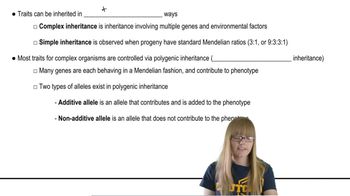
Quantitative Genetics and Polygenic Traits

Quantitative genetics studies traits influenced by multiple genes, called polygenic traits, which show continuous variation like plant height. Each gene contributes a small additive effect to the overall phenotype, resulting in a range of values rather than discrete categories. Understanding this helps explain the variation seen in the F₂ generation.
추천 영상:
가이드 코스
13:40
Traits and Variance

Additive Gene Effects and Segregation in F₂ Generation

Additive gene effects mean that the total phenotype is the sum of contributions from individual alleles. In the F₂ generation, segregation and recombination of alleles produce a wider range of phenotypes, including extremes (e.g., 12 cm and 36 cm plants), reflecting different combinations of gene effects.
추천 영상:
가이드 코스
03:38
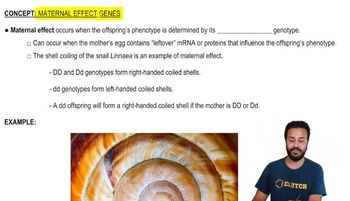
Maternal Effect

Genetic Variance and Phenotypic Distribution

Genetic variance arises from differences in alleles at multiple loci affecting a trait. The phenotypic distribution in the F₂ generation often follows a normal distribution with most individuals near the mean and fewer at extremes, illustrating how gene contributions combine to influence traits like height.
추천 영상:
가이드 코스
08:34
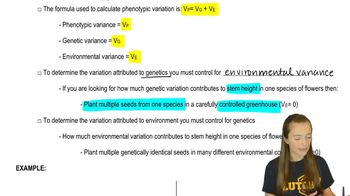
Analyzing Trait Variance
관련 실천
교과서 질문

An inbred strain of plants has a mean height of 24 cm. A second strain of the same species from a different geographic region also has a mean height of 24 cm. When plants from the two strains are crossed together, the F₁ plants are the same height as the parent plants. However, the F₂ generation shows a wide range of heights; the majority are like the P₁ and F₁ plants, but approximately 4 of 1000 are only 12 cm high and about 4 of 1000 are 36 cm high.

What mode of inheritance is occurring here?

594
views
교과서 질문

An inbred strain of plants has a mean height of 24 cm. A second strain of the same species from a different geographic region also has a mean height of 24 cm. When plants from the two strains are crossed together, the F₁ plants are the same height as the parent plants. However, the F₂ generation shows a wide range of heights; the majority are like the P₁ and F₁ plants, but approximately 4 of 1000 are only 12 cm high and about 4 of 1000 are 36 cm high.

How many gene pairs are involved?

712
views
교과서 질문

Height in humans depends on the additive action of genes. Assume that this trait is controlled by the four loci R, S, T, and U and that environmental effects are negligible. Instead of additive versus nonadditive alleles, assume that additive and partially additive alleles exist. Additive alleles contribute two units, and partially additive alleles contribute one unit to height.

If an individual with the minimum height specified by these genes marries an individual of intermediate or moderate height, will any of their children be taller than the tall parent? Why or why not?

699
views
교과서 질문

An inbred strain of plants has a mean height of 24 cm. A second strain of the same species from a different geographic region also has a mean height of 24 cm. When plants from the two strains are crossed together, the F₁ plants are the same height as the parent plants. However, the F₂ generation shows a wide range of heights; the majority are like the P₁ and F₁ plants, but approximately 4 of 1000 are only 12 cm high and about 4 of 1000 are 36 cm high.

Indicate three possible genotypes that could account for F₂ plants that are 18 cm high and three that account for F₂ plants that are 33 cm high.

463
views
교과서 질문

An inbred strain of plants has a mean height of 24 cm. A second strain of the same species from a different geographic region also has a mean height of 24 cm. When plants from the two strains are crossed together, the F₁ plants are the same height as the parent plants. However, the F₂ generation shows a wide range of heights; the majority are like the P₁ and F₁ plants, but approximately 4 of 1000 are only 12 cm high and about 4 of 1000 are 36 cm high.

Indicate one possible set of genotypes for the original P₁ parents and the F₁ plants that could account for these results.

623
views
교과서 질문

Erma and Harvey were a compatible barnyard pair, but a curious sight. Harvey's tail was only 6 cm long, while Erma's was 30 cm. Their F₁ piglet offspring all grew tails that were 18 cm. When inbred, an F₂ generation resulted in many piglets (Erma and Harvey's grandpigs), whose tails ranged in 4-cm intervals from 6 to 30 cm (6, 10, 14, 18, 22, 26, and 30). Most had 18-cm tails, while 1/64 had 6-cm tails and 1/64 had 30-cm tails.

Explain how these tail lengths were inherited by describing the mode of inheritance, indicating how many gene pairs were at work, and designating the genotypes of Harvey, Erma, and their 18-cm-tail offspring.

562
views