Ch. 25 - Quantitative Genetics and Multifactorial Traits
Klug - Concepts of Genetics 12th Edition
Klug12th EditionConcepts of GeneticsISBN: 9780135564776당신이 사용하는 게 아니라요?교과서 변경
25장, 문제 7b

Erma and Harvey were a compatible barnyard pair, but a curious sight. Harvey's tail was only 6 cm long, while Erma's was 30 cm. Their F₁ piglet offspring all grew tails that were 18 cm. When inbred, an F₂ generation resulted in many piglets (Erma and Harvey's grandpigs), whose tails ranged in 4-cm intervals from 6 to 30 cm (6, 10, 14, 18, 22, 26, and 30). Most had 18-cm tails, while 1/64 had 6-cm tails and 1/64 had 30-cm tails.
If one of the 18-cm-tail F₁ pigs is mated with one of the 6-cm-tail F₂ pigs, what phenotypic ratio will be predicted if many offspring resulted? Diagram the cross.

검증된 단계별 안내
1
Step 1: Identify the inheritance pattern. The tail length varies in 4-cm intervals and the F1 offspring have an intermediate tail length (18 cm) between the parents (6 cm and 30 cm). This suggests incomplete dominance with multiple alleles or additive gene action, where tail length is determined by the sum of alleles from each parent.
Step 2: Assign genotypes to the parents. Let’s denote alleles corresponding to tail length increments. For example, assign 'A' alleles contributing 6 cm each. Harvey (6 cm) would be homozygous for the smallest allele (e.g., aa), Erma (30 cm) homozygous for the largest (e.g., AA), and the F1 (18 cm) heterozygous (e.g., Aa). The F2 generation shows a 1:6:15:20:15:6:1 distribution, consistent with a trinomial expansion of a three-allele system or multiple additive loci.
Step 3: Determine the genotype of the 6-cm-tail F2 pig. Since 6 cm is the smallest tail length, this pig is likely homozygous for the smallest allele (aa). The 18-cm F1 pig is heterozygous (Aa).
Step 4: Set up the Punnett square for the cross between the 18-cm F1 pig (Aa) and the 6-cm F2 pig (aa). The possible gametes from Aa are A and a; from aa, only a. The offspring genotypes will be Aa and aa.
Step 5: Predict the phenotypic ratio. Since Aa corresponds to 18 cm and aa to 6 cm, the offspring will be 50% 18-cm tails and 50% 6-cm tails. Diagram the cross showing the gametes and resulting genotypes to visualize this ratio.

비슷한 문제에 대한 검증된 영상 답변:

이 영상 해법은 위 문제에 도움이 된다고 튜터들이 추천한 것입니다.
영상 길이:
2m
도움이 되었나요?

주요 개념

질문에 올바르게 답하기 위해 반드시 이해해야 하는 핵심 개념들은 다음과 같습니다.

Incomplete Dominance and Quantitative Traits

Incomplete dominance occurs when heterozygotes display an intermediate phenotype between the two homozygotes, as seen in the F₁ piglets with 18 cm tails. Quantitative traits, like tail length here, are controlled by multiple alleles or gene copies, producing a range of phenotypes in the offspring rather than discrete categories.
추천 영상:
가이드 코스
04:37
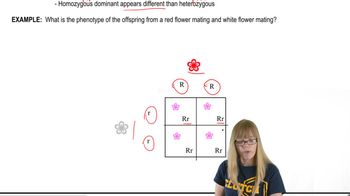
Variations on Dominance

Polygenic Inheritance and Additive Gene Effects

Polygenic inheritance involves multiple genes contributing additively to a trait, resulting in continuous variation such as the 4-cm interval tail lengths in the F₂ generation. Each gene adds a small effect, and the combination of alleles determines the phenotype, explaining the range and frequency distribution observed.
추천 영상:
가이드 코스
03:38
Maternal Effect

Punnett Square and Predicting Phenotypic Ratios

A Punnett square is a tool to diagram genetic crosses and predict offspring genotypes and phenotypes. By assigning alleles to represent tail length contributions, one can cross an 18-cm F₁ pig with a 6-cm F₂ pig to calculate expected phenotypic ratios based on allele combinations and additive effects.
추천 영상:
가이드 코스
02:48
Chi Square Analysis
관련 실천
교과서 질문

In the following table, average differences of height, weight, and fingerprint ridge count between monozygotic twins (reared together and apart), dizygotic twins, and nontwin siblings are compared: 

Based on the data in this table, which of these quantitative traits has the highest heritability values?

688
views
교과서 질문

List as many human traits as you can that are likely to be under the control of a polygenic mode of inheritance.

462
views
교과서 질문

What kind of heritability estimates (broad sense or narrow sense) are obtained from human twin studies?

1192
views
교과서 질문

An inbred strain of plants has a mean height of 24 cm. A second strain of the same species from a different geographic region also has a mean height of 24 cm. When plants from the two strains are crossed together, the F₁ plants are the same height as the parent plants. However, the F₂ generation shows a wide range of heights; the majority are like the P₁ and F₁ plants, but approximately 4 of 1000 are only 12 cm high and about 4 of 1000 are 36 cm high.

Indicate three possible genotypes that could account for F₂ plants that are 18 cm high and three that account for F₂ plants that are 33 cm high.

463
views
교과서 질문

An inbred strain of plants has a mean height of 24 cm. A second strain of the same species from a different geographic region also has a mean height of 24 cm. When plants from the two strains are crossed together, the F₁ plants are the same height as the parent plants. However, the F₂ generation shows a wide range of heights; the majority are like the P₁ and F₁ plants, but approximately 4 of 1000 are only 12 cm high and about 4 of 1000 are 36 cm high.

Indicate one possible set of genotypes for the original P₁ parents and the F₁ plants that could account for these results.

623
views
교과서 질문

Erma and Harvey were a compatible barnyard pair, but a curious sight. Harvey's tail was only 6 cm long, while Erma's was 30 cm. Their F₁ piglet offspring all grew tails that were 18 cm. When inbred, an F₂ generation resulted in many piglets (Erma and Harvey's grandpigs), whose tails ranged in 4-cm intervals from 6 to 30 cm (6, 10, 14, 18, 22, 26, and 30). Most had 18-cm tails, while 1/64 had 6-cm tails and 1/64 had 30-cm tails.

Explain how these tail lengths were inherited by describing the mode of inheritance, indicating how many gene pairs were at work, and designating the genotypes of Harvey, Erma, and their 18-cm-tail offspring.

562
views