Ch. 25 - Quantitative Genetics and Multifactorial Traits
Klug - Concepts of Genetics 12th Edition
Klug12th EditionConcepts of GeneticsISBN: 9780135564776당신이 사용하는 게 아니라요?교과서 변경
25장, 문제 28a

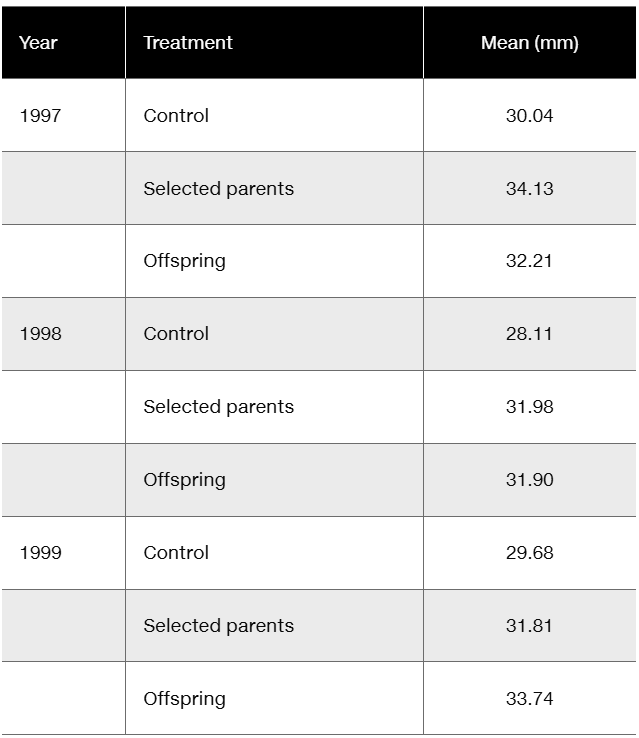
Floral traits in plants often play key roles in diversification, in that slight modifications of those traits, if genetically determined, may quickly lead to reproductive restrictions and evolution. Insight into genetic involvement in flower formation is often acquired through selection experiments that expose realized heritability. Lendvai and Levin (2003) conducted a series of artificial selection experiments on flower size (diameter) in Phlox drummondii. Data from their selection experiments are presented in the following table in modified form and content.
Table showing flower diameter means in mm for control, selected parents, and offspring across 1997-1999 in selection experiments.
Considering that differences in control values represent year-to-year differences in greenhouse conditions, calculate (in mm) the average response to selection over the three-year period. 

검증된 단계별 안내
1
Step 1: Understand the concept of response to selection (R). It is calculated as the difference between the mean trait value of the offspring and the mean trait value of the control group for each year. The formula is: R=Mean(Offspring)-Mean(Control).
Step 2: For each year (1997, 1998, and 1999), calculate the response to selection using the data provided in the table. Subtract the control mean from the offspring mean for each year.
Step 3: Once the response to selection (R) is calculated for each year, sum up the values of R across the three years.
Step 4: Divide the total response to selection by the number of years (3) to calculate the average response to selection over the three-year period. The formula is: Average=Sum(R)3.
Step 5: Interpret the average response to selection value in the context of the experiment, noting how flower size evolved under artificial selection over the three-year period.

비슷한 문제에 대한 검증된 영상 답변:

이 영상 해법은 위 문제에 도움이 된다고 튜터들이 추천한 것입니다.
영상 길이:
2m
도움이 되었나요?

주요 개념

질문에 올바르게 답하기 위해 반드시 이해해야 하는 핵심 개념들은 다음과 같습니다.

Heritability

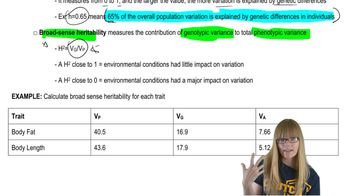
Heritability refers to the proportion of observed variation in a trait among individuals that can be attributed to genetic differences. It is a key concept in genetics, particularly in understanding how traits are passed from one generation to the next. In the context of the selection experiments, heritability helps determine how much of the variation in flower size is due to genetic factors versus environmental influences.
추천 영상:
가이드 코스
07:04
Calculating Heritability

Artificial Selection

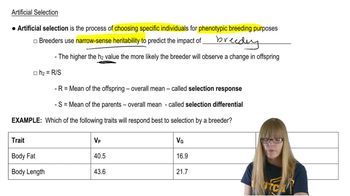
Artificial selection is a process by which humans breed plants or animals for specific traits. In the case of the Phlox drummondii experiments, researchers selected for larger flower sizes over multiple generations. This method allows scientists to study the genetic basis of traits and observe how selection pressures can lead to changes in those traits over time.
추천 영상:
가이드 코스
04:15
Artificial Selection

Response to Selection

Response to selection is the change in the average trait value in a population due to selection over time. It is calculated by measuring the difference in trait values before and after selection. In the context of the question, calculating the average response to selection for flower size involves analyzing the data from the experiments to determine how much the average size of flowers has changed as a result of the selection process.
추천 영상:
가이드 코스
04:15
Artificial Selection
관련 실천
교과서 질문

Floral traits in plants often play key roles in diversification, in that slight modifications of those traits, if genetically determined, may quickly lead to reproductive restrictions and evolution. Insight into genetic involvement in flower formation is often acquired through selection experiments that expose realized heritability. Lendvai and Levin (2003) conducted a series of artificial selection experiments on flower size (diameter) in Phlox drummondii. Data from their selection experiments are presented in the following table in modified form and content.

In terms of evolutionary potential, is a population with high heritability likely to be favored compared to one with a low realized heritability? 

455
views
교과서 질문

Consider a true-breeding plant, AABBCC, crossed with another true-breeding plant, aabbcc, whose resulting offspring are AaBbCc. If you cross the F₁ generation, and independent assortment is operational, the expected fraction of offspring in each phenotypic class is given by the expression N!/M!(N−M)! where N is the total number of alleles (six in this example) and M is the number of uppercase alleles. In a cross of AaBbCc×AaBbCc, what proportion of the offspring would be expected to contain two uppercase alleles?

549
views
교과서 질문

Floral traits in plants often play key roles in diversification, in that slight modifications of those traits, if genetically determined, may quickly lead to reproductive restrictions and evolution. Insight into genetic involvement in flower formation is often acquired through selection experiments that expose realized heritability. Lendvai and Levin (2003) conducted a series of artificial selection experiments on flower size (diameter) in Phlox drummondii. Data from their selection experiments are presented in the following table in modified form and content.

Calculate the realized heritability for each year and the overall realized heritability. 

491
views
교과서 질문

Students in a genetics laboratory began an experiment in an attempt to increase heat tolerance in two strains of Drosophila melanogaster. One strain was trapped from the wild six weeks before the experiment was to begin; the other was obtained from a Drosophila repository at a university laboratory. In which strain would you expect to see the most rapid and extensive response to heat-tolerance selection, and why?

513
views
교과서 질문

Floral traits in plants often play key roles in diversification, in that slight modifications of those traits, if genetically determined, may quickly lead to reproductive restrictions and evolution. Insight into genetic involvement in flower formation is often acquired through selection experiments that expose realized heritability. Lendvai and Levin (2003) conducted a series of artificial selection experiments on flower size (diameter) in Phlox drummondii. Data from their selection experiments are presented in the following table in modified form and content.

Assuming that the realized heritability in phlox is relatively high, what factors might account for such a high response?

421
views
교과서 질문

Floral traits in plants often play key roles in diversification, in that slight modifications of those traits, if genetically determined, may quickly lead to reproductive restrictions and evolution. Insight into genetic involvement in flower formation is often acquired through selection experiments that expose realized heritability. Lendvai and Levin (2003) conducted a series of artificial selection experiments on flower size (diameter) in Phlox drummondii. Data from their selection experiments are presented in the following table in a modified form and content.

Considering that differences in control values represent year-to-year differences in greenhouse conditions, calculate (in mm) the average response to selection over the three-year period

421
views