Ch. 25 - Quantitative Genetics and Multifactorial Traits
Klug - Concepts of Genetics 12th Edition
Klug12th EditionConcepts of GeneticsISBN: 9780135564776당신이 사용하는 게 아니라요?교과서 변경
25장, 문제 25

Students in a genetics laboratory began an experiment in an attempt to increase heat tolerance in two strains of Drosophila melanogaster. One strain was trapped from the wild six weeks before the experiment was to begin; the other was obtained from a Drosophila repository at a university laboratory. In which strain would you expect to see the most rapid and extensive response to heat-tolerance selection, and why?

검증된 단계별 안내
1
Understand the concept of genetic variation: Genetic variation refers to the diversity in gene frequencies within a population. Populations with higher genetic variation have a greater potential for adaptation to environmental changes, such as heat tolerance.
Analyze the two strains: The wild strain of Drosophila melanogaster is likely to have higher genetic variation because it has been exposed to natural environmental pressures, which promote diverse genetic traits. In contrast, the laboratory strain may have undergone controlled breeding, reducing genetic diversity.
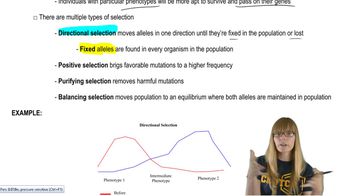
Consider the role of selection pressure: Selection pressure, such as heat tolerance, acts on existing genetic variation. A population with greater genetic variation will have more individuals with traits that can be selected for heat tolerance, leading to a faster and more extensive response.
Evaluate the expected response: The wild strain is expected to show a more rapid and extensive response to heat-tolerance selection due to its higher genetic variation. The laboratory strain may respond more slowly or less extensively because of reduced genetic diversity.
Summarize the reasoning: The wild strain's exposure to natural environments likely resulted in greater genetic diversity, making it better equipped to adapt to heat-tolerance selection compared to the laboratory strain, which may have been subject to genetic bottlenecks or reduced variation.

비슷한 문제에 대한 검증된 영상 답변:

이 영상 해법은 위 문제에 도움이 된다고 튜터들이 추천한 것입니다.
영상 길이:
1m
도움이 되었나요?

주요 개념

질문에 올바르게 답하기 위해 반드시 이해해야 하는 핵심 개념들은 다음과 같습니다.

Natural Selection

Natural selection is a fundamental mechanism of evolution where organisms better adapted to their environment tend to survive and produce more offspring. In the context of the Drosophila strains, the wild strain may have already undergone natural selection for heat tolerance, potentially leading to a more rapid response to selection pressures compared to the laboratory strain, which may have been bred under controlled conditions.
추천 영상:
가이드 코스
05:54
Natural Selection

Genetic Variation

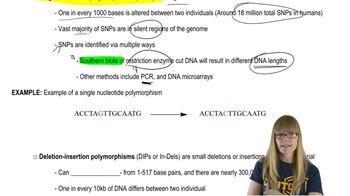
Genetic variation refers to the diversity in gene frequencies within a population. It is crucial for evolution and adaptation, as it provides the raw material for natural selection. The wild strain of Drosophila may exhibit greater genetic variation due to its exposure to diverse environmental pressures, which could enhance its ability to adapt to heat tolerance more quickly than the more homogenous laboratory strain.
추천 영상:
가이드 코스
09:28
Genomic Variation

Phenotypic Plasticity

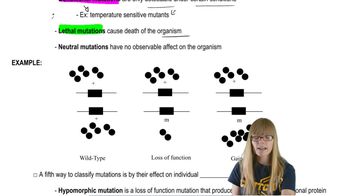
Phenotypic plasticity is the ability of an organism to change its phenotype in response to environmental conditions. This concept is important in understanding how Drosophila can adapt to heat stress. The wild strain may possess greater phenotypic plasticity, allowing it to exhibit a range of responses to heat that could facilitate a more rapid adaptation compared to the laboratory strain, which may have a more fixed phenotype due to selective breeding.
추천 영상:
가이드 코스
10:48
Mutations and Phenotypes
관련 실천
교과서 질문

In a series of crosses between two true-breeding strains of peaches, the F₁ generation was uniform, producing 30-g peaches. The F₂ fruit mass ranges from 38 to 22 g at intervals of 2 g.

Using these data, determine the number of polygenic loci involved in the inheritance of peach mass.

686
views
교과서 질문

Type A1B brachydactyly (short middle phalanges) is a genetically determined trait that maps to the short arm of chromosome 5 in humans. If you classify individuals as either having or not having brachydactyly, the trait appears to follow a single-locus, incompletely dominant pattern of inheritance. However, if one examines the fingers and toes of affected individuals, one sees a range of expression from extremely short to only slightly short. What might cause such variation in the expression of brachydactyly?

456
views
교과서 질문

Consider a true-breeding plant, AABBCC, crossed with another true-breeding plant, aabbcc, whose resulting offspring are AaBbCc. If you cross the F₁ generation, and independent assortment is operational, the expected fraction of offspring in each phenotypic class is given by the expression N!/M!(N−M)! where N is the total number of alleles (six in this example) and M is the number of uppercase alleles. In a cross of AaBbCc×AaBbCc, what proportion of the offspring would be expected to contain two uppercase alleles?

549
views
교과서 질문

In a series of crosses between two true-breeding strains of peaches, the F₁ generation was uniform, producing 30-g peaches. The F₂ fruit mass ranges from 38 to 22 g at intervals of 2 g.

Using gene symbols of your choice, give the genotypes of the parents and the F₂.

610
views
교과서 질문

Floral traits in plants often play key roles in diversification, in that slight modifications of those traits, if genetically determined, may quickly lead to reproductive restrictions and evolution. Insight into genetic involvement in flower formation is often acquired through selection experiments that expose realized heritability. Lendvai and Levin (2003) conducted a series of artificial selection experiments on flower size (diameter) in Phlox drummondii. Data from their selection experiments are presented in the following table in modified form and content.

Considering that differences in control values represent year-to-year differences in greenhouse conditions, calculate (in mm) the average response to selection over the three-year period. 

432
views
교과서 질문

Floral traits in plants often play key roles in diversification, in that slight modifications of those traits, if genetically determined, may quickly lead to reproductive restrictions and evolution. Insight into genetic involvement in flower formation is often acquired through selection experiments that expose realized heritability. Lendvai and Levin (2003) conducted a series of artificial selection experiments on flower size (diameter) in Phlox drummondii. Data from their selection experiments are presented in the following table in a modified form and content.

Considering that differences in control values represent year-to-year differences in greenhouse conditions, calculate (in mm) the average response to selection over the three-year period

421
views