Ch. 25 - Quantitative Genetics and Multifactorial Traits
Klug - Concepts of Genetics 12th Edition
Klug12th EditionConcepts of GeneticsISBN: 9780135564776당신이 사용하는 게 아니라요?교과서 변경
25장, 문제 18

In a population of tomato plants, mean fruit weight is 60 g and is 0.3. Predict the mean weight of the progeny if tomato plants whose fruit averaged 80 g were selected from the original population and interbred.

검증된 단계별 안내
1
Identify the given information: the population mean fruit weight (\( \bar{P} = 60 \) g), the heritability in the narrow sense (\( h^2 = 0.3 \)), and the mean fruit weight of the selected parents (\( \bar{S} = 80 \) g).
Calculate the selection differential (\( S \)), which is the difference between the mean of the selected parents and the population mean: \[ S = \bar{S} - \bar{P} \]
Use the breeder's equation to predict the response to selection (\( R \)), which is the expected change in the progeny mean compared to the original population mean: \[ R = h^2 \times S \]
Calculate the predicted mean fruit weight of the progeny (\( \bar{P'} \)) by adding the response to selection to the original population mean: \[ \bar{P'} = \bar{P} + R \]
Interpret the result as the expected average fruit weight of the progeny from the selected parents, considering the heritability and selection differential.

비슷한 문제에 대한 검증된 영상 답변:

이 영상 해법은 위 문제에 도움이 된다고 튜터들이 추천한 것입니다.
영상 길이:
2m
도움이 되었나요?

주요 개념

질문에 올바르게 답하기 위해 반드시 이해해야 하는 핵심 개념들은 다음과 같습니다.

Heritability (h²)

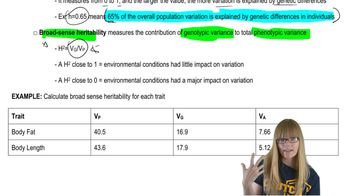
Heritability in the narrow sense (h²) measures the proportion of phenotypic variance in a population that is due to additive genetic factors. It ranges from 0 to 1 and indicates how much of the trait variation can be passed from parents to offspring. A higher h² means stronger genetic influence on the trait.
추천 영상:
가이드 코스
07:04
Calculating Heritability

Selection Differential (S)

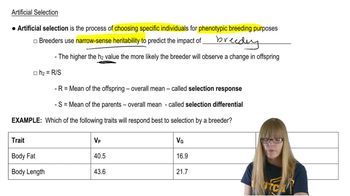
The selection differential is the difference between the mean phenotype of the selected parents and the mean phenotype of the original population. It quantifies the strength of selection applied and is used to predict the response to selection in the next generation.
추천 영상:
가이드 코스
04:15
Artificial Selection

Response to Selection (R)

Response to selection is the change in the mean phenotype of the progeny compared to the original population mean. It is calculated as R = h² × S, showing how much the trait mean shifts due to selection based on heritability and selection differential.
추천 영상:
가이드 코스
04:15
Artificial Selection
관련 실천
교과서 질문

In an assessment of learning in Drosophila, flies were trained to avoid certain olfactory cues. In one population, a mean of 8.5 trials was required. A subgroup of this parental population that was trained most quickly (mean=6.0) was interbred, and their progeny were examined. These flies demonstrated a mean training value of 7.5. Calculate realized heritability for olfactory learning in Drosophila.

438
views
교과서 질문

In a population of 100 inbred, genotypically identical rice plants, variance for grain yield is 4.67. What is the heritability for yield? Would you advise a rice breeder to improve yield in this strain of rice plants by selection?

720
views
교과서 질문

Suppose you want to develop a population of Drosophila that would rapidly learn to avoid certain substances the flies could detect by smell. Based on the heritability estimate you obtained in Problem 16, do you think it would be worth doing this by artificial selection? Why or why not?

468
views
교과서 질문

Many traits of economic or medical significance are determined by quantitative trait loci (QTLs) in which many genes, usually scattered throughout the genome, contribute to expression.

What general procedures are used to identify such loci?

426
views
교과서 질문

In a herd of dairy cows the narrow-sense heritability for milk protein content is 0.76, and for milk butterfat it is 0.82. The correlation coefficient between milk protein content and butterfat is 0.91. If the farmer selects for cows producing more butterfat in their milk, what will be the most likely effect on milk protein content in the next generation?

545
views
교과서 질문

Many traits of economic or medical significance are determined by quantitative trait loci (QTLs) in which many genes, usually scattered throughout the genome, contribute to expression.

What is meant by the term cosegregate in the context of QTL mapping? Why are markers such as RFLPs, SNPs, and microsatellites often used in QTL mapping?

454
views