Ch. 25 - Quantitative Genetics and Multifactorial Traits
Klug - Concepts of Genetics 12th Edition
Klug12th EditionConcepts of GeneticsISBN: 9780135564776당신이 사용하는 게 아니라요?교과서 변경
25장, 문제 20b

Many traits of economic or medical significance are determined by quantitative trait loci (QTLs) in which many genes, usually scattered throughout the genome, contribute to expression.
What is meant by the term cosegregate in the context of QTL mapping? Why are markers such as RFLPs, SNPs, and microsatellites often used in QTL mapping?

검증된 단계별 안내
1
Step 1: Define the term 'cosegregate' in the context of QTL mapping. Cosegregation refers to the phenomenon where a genetic marker and a trait of interest are inherited together in offspring due to their physical proximity on the same chromosome. This linkage suggests that the marker is near a gene influencing the trait.
Step 2: Explain the importance of genetic markers in QTL mapping. Genetic markers, such as RFLPs (Restriction Fragment Length Polymorphisms), SNPs (Single Nucleotide Polymorphisms), and microsatellites, are used to identify regions of the genome associated with specific traits. These markers act as signposts to locate genes contributing to quantitative traits.
Step 3: Discuss why RFLPs are useful in QTL mapping. RFLPs are variations in DNA sequences that can be detected by restriction enzymes. They are valuable because they provide a way to distinguish between different alleles at a locus, aiding in the identification of linked traits.
Step 4: Explain the role of SNPs in QTL mapping. SNPs are single base-pair changes in the DNA sequence and are highly abundant throughout the genome. Their high density makes them ideal for fine-scale mapping of QTLs, as they can pinpoint regions associated with traits more precisely.
Step 5: Describe the significance of microsatellites in QTL mapping. Microsatellites are short, repetitive DNA sequences that vary in length between individuals. Their high variability and ease of detection make them useful for tracking inheritance patterns and identifying genomic regions linked to quantitative traits.

비슷한 문제에 대한 검증된 영상 답변:

이 영상 해법은 위 문제에 도움이 된다고 튜터들이 추천한 것입니다.
영상 길이:
1m
도움이 되었나요?

주요 개념

질문에 올바르게 답하기 위해 반드시 이해해야 하는 핵심 개념들은 다음과 같습니다.

Cosegregation

Cosegregation refers to the phenomenon where two or more genetic markers or traits are inherited together more often than would be expected by chance. In the context of QTL mapping, it indicates that a specific marker is linked to a trait of interest, allowing researchers to track the inheritance of that trait through generations. This is crucial for identifying the genetic basis of quantitative traits.

Quantitative Trait Loci (QTL)

Quantitative Trait Loci (QTL) are regions of the genome that are associated with the variation in a quantitative trait, which is a trait that can be measured and is influenced by multiple genes. QTL mapping helps identify these regions by correlating phenotypic data with genetic markers, enabling researchers to understand the genetic architecture of complex traits, such as height or disease susceptibility.
추천 영상:

Genetic Markers (RFLPs, SNPs, Microsatellites)

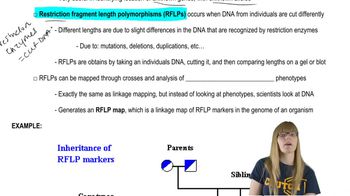
Genetic markers like Restriction Fragment Length Polymorphisms (RFLPs), Single Nucleotide Polymorphisms (SNPs), and microsatellites are used in QTL mapping to identify specific locations in the genome associated with traits. These markers are valuable because they are abundant, easily detectable, and can provide high-resolution mapping of QTLs, facilitating the understanding of genetic contributions to traits of interest.
추천 영상:
가이드 코스
07:11
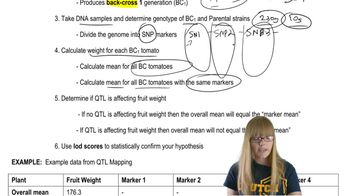
Mapping with Markers
관련 실천
교과서 질문

In a population of 100 inbred, genotypically identical rice plants, variance for grain yield is 4.67. What is the heritability for yield? Would you advise a rice breeder to improve yield in this strain of rice plants by selection?

720
views
교과서 질문

A 3-inch plant was crossed with a 15-inch plant, and all F₁ plants were 9 inches. The F₂ plants exhibited a 'normal distribution,' with heights of 3, 4, 5, 6, 7, 8, 9, 10, 11, 12, 13, 14, and 15 inches.

What ratio will constitute the 'normal distribution' in the F₂?

376
views
교과서 질문

Many traits of economic or medical significance are determined by quantitative trait loci (QTLs) in which many genes, usually scattered throughout the genome, contribute to expression.

What general procedures are used to identify such loci?

426
views
교과서 질문

In a population of tomato plants, mean fruit weight is 60 g and is 0.3. Predict the mean weight of the progeny if tomato plants whose fruit averaged 80 g were selected from the original population and interbred.

426
views
교과서 질문

In a cross between a strain of large guinea pigs and a strain of small guinea pigs, the F₁ are phenotypically uniform, with an average size about intermediate between that of the two parental strains. Among 1014 F₂ individuals, 3 are about the same size as the small parental strain and 5 are about the same size as the large parental strain. How many gene pairs are involved in the inheritance of size in these strains of guinea pigs?

531
views
교과서 질문

A 3-inch plant was crossed with a 15-inch plant, and all F₁ plants were 9 inches. The F₂ plants exhibited a 'normal distribution,' with heights of 3, 4, 5, 6, 7, 8, 9, 10, 11, 12, 13, 14, and 15 inches.

What will be the outcome if the F₁ plants are testcrossed with plants that are homozygous for all nonadditive alleles?

627
views