Ch. 26 - Population and Evolutionary Genetics
Klug - Concepts of Genetics 12th Edition
Klug12th EditionConcepts of GeneticsISBN: 9780135564776당신이 사용하는 게 아니라요?교과서 변경
26장, 문제 14

One of the first Mendelian traits identified in humans was a dominant condition known as brachydactyly. This gene causes an abnormal shortening of the fingers or toes (or both). At the time, some researchers thought that the dominant trait would spread until 75 percent of the population would be affected (because the phenotypic ratio of dominant to recessive is 3 : 1). Show that the reasoning was incorrect.

검증된 단계별 안내
1
Understand that the 3:1 phenotypic ratio (dominant : recessive) applies to the offspring of heterozygous parents in a controlled Mendelian cross, not directly to the overall population frequency.
Define the frequency of the dominant allele as \(p\) and the recessive allele as \(q\), where \(p + q = 1\) in the population under Hardy-Weinberg equilibrium.
Recall that the frequency of individuals showing the dominant phenotype is given by \(p^2 + 2pq\), since both homozygous dominant (\(p^2\)) and heterozygous (\$2pq$) genotypes express the dominant trait.
Note that the frequency of the recessive phenotype is \(q^2\), representing homozygous recessive individuals.
Use the relationship \(p + q = 1\) and the expression for dominant phenotype frequency \(p^2 + 2pq = 1 - q^2\) to show that the maximum proportion of affected individuals cannot simply be 75%, because this depends on allele frequencies in the population, not just Mendelian ratios from a single cross.

비슷한 문제에 대한 검증된 영상 답변:

이 영상 해법은 위 문제에 도움이 된다고 튜터들이 추천한 것입니다.
영상 길이:
2m
도움이 되었나요?

주요 개념

질문에 올바르게 답하기 위해 반드시 이해해야 하는 핵심 개념들은 다음과 같습니다.

Mendelian Inheritance and Phenotypic Ratios

Mendelian inheritance describes how traits are passed from parents to offspring through dominant and recessive alleles. A 3:1 phenotypic ratio typically appears in a monohybrid cross of heterozygotes, meaning 75% of offspring show the dominant trait in that specific generation, not the entire population over time.
추천 영상:
가이드 코스
10:48
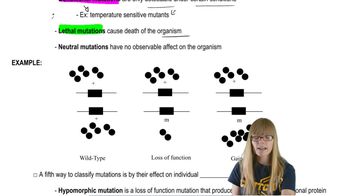
Mutations and Phenotypes

Allele Frequency vs. Phenotypic Ratio

Phenotypic ratios describe the proportion of traits in offspring from specific crosses, while allele frequencies represent how common an allele is in a population. The 3:1 ratio applies to offspring genotypes, not to the overall population frequency, which is influenced by factors like mating patterns and selection.
추천 영상:
가이드 코스
03:03
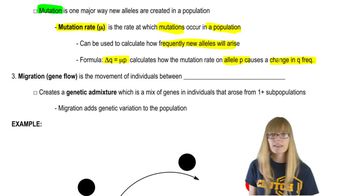
New Alleles and Migration

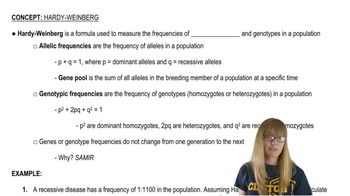
Population Genetics and Hardy-Weinberg Equilibrium

Population genetics studies allele frequencies in populations over time. Hardy-Weinberg equilibrium predicts stable allele frequencies without evolutionary forces. A dominant trait does not necessarily increase to 75% prevalence because allele frequencies depend on genotype proportions and fitness, not just dominance.
추천 영상:
관련 실천
교과서 질문

Describe how populations with substantial genetic differences can form. What is the role of natural selection?

825
views
교과서 질문

Assume that a recessive autosomal disorder occurs in 1 of 10,000 individuals (0.0001) in the general population and that in this population about 2 percent (0.02) of the individuals are carriers for the disorder. Estimate the probability of this disorder occurring in the offspring of a marriage between first cousins. Compare this probability to the population at large.

620
views
교과서 질문

If the initial allele frequencies are p = 0.5 and q = 0.5 and allele a is a lethal recessive, what will be the frequencies after 1, 5, 10, 25, 100, and 1000 generations?

983
views
교과서 질문

A recent study examining the mutation rates of 5669 mammalian genes (17,208 sequences) indicates that, contrary to popular belief, mutation rates among lineages with vastly different generation lengths and physiological attributes are remarkably constant [Kumar, S., and Subramanian, S. (2002). Proc. Natl. Acad. Sci. USA 99:803–808]. The average rate is estimated at 12.2×10⁻⁹ per bp per year. What is the significance of this finding in terms of mammalian evolution?

408
views
교과서 질문

Under what circumstances might a lethal dominant allele persist in a population?

520
views
교과서 질문

Achondroplasia is a dominant trait that causes a characteristic form of dwarfism. In a survey of 50,000 births, five infants with achondroplasia were identified. Three of the affected infants had affected parents, while two had normal parents. Calculate the mutation rate for achondroplasia and express the rate as the number of mutant genes per given number of gametes.

830
views