
교과서 질문
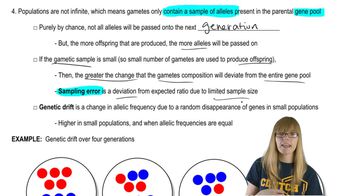
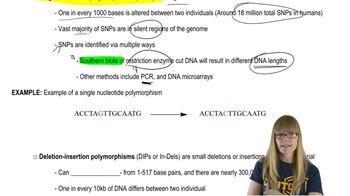
Describe how populations with substantial genetic differences can form. What is the role of natural selection?
825
views

 검증된 단계별 안내
 10:15
10:15
 09:28
09:28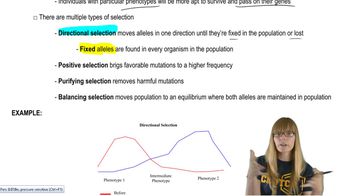 05:54
05:54Describe how populations with substantial genetic differences can form. What is the role of natural selection?
A farmer plants transgenic Bt corn that is genetically modified to produce its own insecticide. Of the corn borer larvae feeding on these Bt crop plants, only 10 percent survive unless they have at least one copy of the dominant resistance allele B that confers resistance to the Bt insecticide. When the farmer first plants Bt corn, the frequency of the B resistance allele in the corn borer population is 0.02. What will be the frequency of the resistance allele after one generation of corn borers have fed on Bt corn?
A botanist studying water lilies in an isolated pond observed three leaf shapes in the population: round, arrowhead, and scalloped. Marker analysis of DNA from 125 individuals showed the round-leaf plants to be homozygous for allele r1, while the plants with arrowhead leaves were homozygous for a different allele at the same locus, r2. Plants with scalloped leaves showed DNA profiles with both the r1 and r2 alleles. Frequency of the r1 allele was estimated at 0.81. If the botanist counted 20 plants with scalloped leaves in the pond, what is the inbreeding coefficient F for this population?
A recent study examining the mutation rates of 5669 mammalian genes (17,208 sequences) indicates that, contrary to popular belief, mutation rates among lineages with vastly different generation lengths and physiological attributes are remarkably constant [Kumar, S., and Subramanian, S. (2002). Proc. Natl. Acad. Sci. USA 99:803–808]. The average rate is estimated at 12.2×10⁻⁹ per bp per year. What is the significance of this finding in terms of mammalian evolution?
In an isolated population of 50 desert bighorn sheep, a mutant recessive allele c when homozygous causes curled coats in both males and females. The normal dominant allele C produces straight coats. A biologist studying these sheep counts four with curled coats. She also takes blood samples from the population for DNA analysis, which reveals that 17 of the sheep are heterozygous carriers of the c allele. What is the inbreeding coefficient F for this population?
Achondroplasia is a dominant trait that causes a characteristic form of dwarfism. In a survey of 50,000 births, five infants with achondroplasia were identified. Three of the affected infants had affected parents, while two had normal parents. Calculate the mutation rate for achondroplasia and express the rate as the number of mutant genes per given number of gametes.