Ch. 3 - Mendelian Genetics
Klug - Concepts of Genetics 12th Edition
Klug12th EditionConcepts of GeneticsISBN: 9780135564776당신이 사용하는 게 아니라요?교과서 변경
3장, 문제 25a

A 'wrongful birth' case was recently brought before a court in which a child with Smith–Lemli–Opitz syndrome was born to apparently healthy parents. This syndrome is characterized by a cluster of birth defects including cleft palate, and an array of problems with the reproductive and urinary organs. Originally considered by their physician as having a nongenetic basis, the parents decided to have another child, who was also born with Smith–Lemli–Opitz syndrome. In the role of a genetic counselor, instruct the court about what occurred, including the probability of the parents having two affected offspring, knowing that the disorder is inherited as a recessive trait. Draw a pedigree of the families of this couple, showing the relevant individuals.

검증된 단계별 안내
1
Step 1: Understand the inheritance pattern. Smith–Lemli–Opitz syndrome is inherited as an autosomal recessive trait. This means that an individual must inherit two copies of the recessive allele (one from each parent) to express the disorder. Carriers (heterozygous individuals) have one recessive allele and one dominant allele but do not show symptoms.
Step 2: Analyze the pedigree. The pedigree shows two affected children (shaded symbols) in generation II, born to unaffected parents (unshaded symbols). This indicates that both parents are carriers of the recessive allele.
Step 3: Assign genotypes. Represent the dominant allele as 'A' and the recessive allele as 'a'. Since the parents are unaffected but have affected children, their genotypes must be heterozygous (Aa). The affected children must have the genotype 'aa'.
Step 4: Calculate the probability of having two affected offspring. Use a Punnett square to determine the probability of each genotype for the offspring of two heterozygous parents (Aa x Aa). The possible genotypes are: AA (25%), Aa (50%), and aa (25%). The probability of having an affected child (aa) is 25%. The probability of having two affected children is the product of the probabilities for each child: (0.25) x (0.25).
Step 5: Summarize findings for the court. Explain that the disorder is genetic and inherited in an autosomal recessive manner. Both parents are carriers, and the recurrence risk for each child to inherit the disorder is 25%. The probability of having two affected children is the product of individual probabilities. This information highlights the importance of genetic counseling for family planning.

비슷한 문제에 대한 검증된 영상 답변:

이 영상 해법은 위 문제에 도움이 된다고 튜터들이 추천한 것입니다.
영상 길이:
4m
도움이 되었나요?

주요 개념

질문에 올바르게 답하기 위해 반드시 이해해야 하는 핵심 개념들은 다음과 같습니다.

Recessive Inheritance

Recessive inheritance occurs when a trait is expressed only when an individual has two copies of the recessive allele, one inherited from each parent. In the case of Smith–Lemli–Opitz syndrome, which is inherited as a recessive trait, both parents must be carriers of the mutated gene for their offspring to be affected. This means that even if the parents appear healthy, they can still pass on the recessive allele to their children.
추천 영상:
가이드 코스
05:13
Organelle Inheritance

Punnett Square

A Punnett square is a tool used in genetics to predict the probability of an offspring inheriting particular traits from its parents. By mapping out the possible combinations of alleles from each parent, it helps to visualize the likelihood of different genotypes and phenotypes in the offspring. For Smith–Lemli–Opitz syndrome, a Punnett square can illustrate the chances of the parents having affected children based on their carrier status.
추천 영상:
가이드 코스
18:27
Chi Square Analysis

Pedigree Analysis

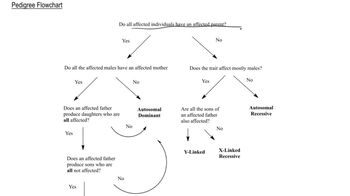
Pedigree analysis is a method used to trace the inheritance patterns of traits through generations in a family. It involves creating a diagram that represents family relationships and the presence or absence of specific traits. In this case, the pedigree chart can help identify how Smith–Lemli–Opitz syndrome is passed down, revealing whether the parents are carriers and the probability of their children being affected.
추천 영상:
가이드 코스
01:59
Pedigree Flowchart
관련 실천
교과서 질문

A 'wrongful birth' case was recently brought before a court in which a child with Smith–Lemli–Opitz syndrome was born to apparently healthy parents. This syndrome is characterized by a cluster of birth defects, including cleft palate, and an array of problems with the reproductive and urinary organs. Originally considered by their physician as having a nongenetic basis, the parents decided to have another child, who was also born with Smith–Lemli–Opitz syndrome. In the role of a genetic counselor, instruct the court about what occurred, including the probability of the parents having two affected offspring, knowing that the disorder is inherited as a recessive trait. What is the probability that neither of them is a carrier?

542
views
교과서 질문
For decades scientists have been perplexed by different circumstances surrounding families with rare, early-onset auditory neuropathy (deafness). In some families, parents and grandparents of the proband have normal hearing, while in other families, a number of affected (deaf) family members are scattered throughout the pedigree, appearing in every generation. Assuming a genetic cause for each case, offer a reasonable explanation for the genetic origin of such deafness in the two types of families.
567
views
교과서 질문

Draw all possible conclusions concerning the mode of inheritance of the trait portrayed in the following limited pedigree.


878
views
교과서 질문

A 'wrongful birth' case was recently brought before a court in which a child with Smith–Lemli–Opitz syndrome was born to apparently healthy parents. This syndrome is characterized by a cluster of birth defects including cleft palate, and an array of problems with the reproductive and urinary organs. Originally considered by their physician as having a nongenetic basis, the parents decided to have another child, who was also born with Smith–Lemli–Opitz syndrome. In the role of a genetic counselor, instruct the court about what occurred, including the probability of the parents having two affected offspring, knowing that the disorder is inherited as a recessive trait. What is the probability that one of them is a carrier and the other is not? [Hint: The p values in (b), (c), and (d) should equal 1.]

484
views
교과서 질문

A 'wrongful birth' case was recently brought before a court in which a child with Smith–Lemli–Opitz syndrome was born to apparently healthy parents. This syndrome is characterized by a cluster of birth defects including cleft palate, and an array of problems with the reproductive and urinary organs. Originally considered by their physician as having a nongenetic basis, the parents decided to have another child, who was also born with Smith–Lemli–Opitz syndrome. In the role of a genetic counselor, instruct the court about what occurred, including the probability of the parents having two affected offspring, knowing that the disorder is inherited as a recessive trait. Calculate the probability that both the male and female are carriers for TSD.

477
views
교과서 질문

A 'wrongful birth' case was recently brought before a court in which a child with Smith–Lemli–Opitz syndrome was born to apparently healthy parents. This syndrome is characterized by a cluster of birth defects including cleft palate, and an array of problems with the reproductive and urinary organs. Originally considered by their physician as having a nongenetic basis, the parents decided to have another child, who was also born with Smith–Lemli–Opitz syndrome. In the role of a genetic counselor, instruct the court about what occurred, including the probability of the parents having two affected offspring, knowing that the disorder is inherited as a recessive trait.

496
views