Ch. 5 - Chromosome Mapping in Eukaryotes
Klug - Concepts of Genetics 12th Edition
Klug12th EditionConcepts of GeneticsISBN: 9780135564776당신이 사용하는 게 아니라요?교과서 변경
5장, 문제 30

In laboratory class, a genetics student was assigned to study an unknown mutation in Drosophila that had a whitish eye. He crossed females from his true-breeding mutant stock to wild-type (brick-red-eyed) males, recovering all wild-type F1 flies. In the F2 generation, the following offspring were recovered in the following proportions:
wild type: 5/8
bright red: 1/8
brown eye: 1/8
white eye: 1/8
The student was stumped until the instructor suggested that perhaps the whitish eye in the original stock was the result of homozygosity for a mutation causing brown eyes and a mutation causing bright red eyes, illustrating gene interaction. After much thought, the student was able to analyze the data, explain the results, and learn several things about the location of the two genes relative to one another. One key to his understanding was that crossing over occurs in Drosophila females but not in males. Based on his analysis, what did the student learn about the two genes?

검증된 단계별 안내
1
Understand the problem: The whitish eye phenotype in the original stock is hypothesized to result from homozygosity for two separate mutations (one causing brown eyes and the other causing bright red eyes). This suggests gene interaction, where the combination of two mutations produces a novel phenotype.
Analyze the F₁ generation: The cross between true-breeding mutant females (whitish eyes) and wild-type males produced all wild-type F₁ flies. This indicates that the wild-type alleles are dominant over the mutant alleles for both genes, and the two mutations are likely recessive.
Analyze the F₂ generation proportions: The F₂ generation shows a phenotypic ratio of 5/8 wild type, 1/8 bright red, 1/8 brown, and 1/8 white. This suggests a dihybrid cross involving two genes with independent assortment, where the white eye phenotype results from homozygosity for both mutations (epistasis).
Consider the role of crossing over: Since crossing over occurs in Drosophila females but not in males, the recombination observed in the F₂ generation must have occurred during gamete formation in the F₁ females. This implies that the two genes are located on the same chromosome but are not completely linked, as recombination is evident.
Conclude the genetic relationship: Based on the data, the student likely learned that the two genes are located on the same chromosome (linked) but are separated by a measurable distance, allowing for recombination. The phenotypic ratios also confirm that the whitish eye phenotype results from an interaction between the two genes (epistasis).

비슷한 문제에 대한 검증된 영상 답변:

이 영상 해법은 위 문제에 도움이 된다고 튜터들이 추천한 것입니다.
영상 길이:
2m
도움이 되었나요?

주요 개념

질문에 올바르게 답하기 위해 반드시 이해해야 하는 핵심 개념들은 다음과 같습니다.

Gene Interaction

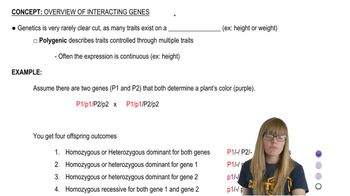
Gene interaction refers to the phenomenon where two or more genes influence a single trait, leading to a variety of phenotypes. In this case, the interaction between mutations for brown and bright red eyes in Drosophila resulted in a whitish eye phenotype. Understanding how these genes interact helps explain the observed ratios in the offspring and the complexity of inheritance patterns.
추천 영상:
가이드 코스
07:56
Interacting Genes Overview

Crossing Over

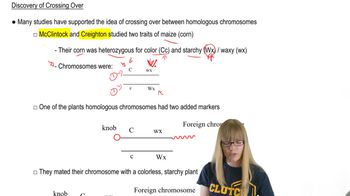
Crossing over is a genetic process that occurs during meiosis, where homologous chromosomes exchange segments of DNA. This process increases genetic diversity and can affect the inheritance of traits. In Drosophila, crossing over occurs in females but not in males, which is crucial for understanding the inheritance patterns observed in the F₂ generation and the relative positioning of the genes on the chromosomes.
추천 영상:
가이드 코스
05:19
Discovery of Crossing Over

Phenotypic Ratios

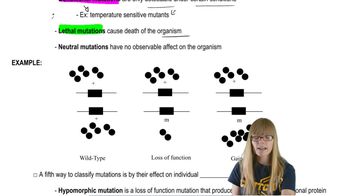
Phenotypic ratios represent the relative frequencies of different phenotypes in the offspring of a genetic cross. The observed ratios in the F₂ generation (5/8 wild type, 1/8 bright red, 1/8 brown, 1/8 white) suggest a complex inheritance pattern influenced by multiple alleles and gene interactions. Analyzing these ratios allows the student to infer the genetic relationships and interactions between the alleles involved.
추천 영상:
가이드 코스
10:48
Mutations and Phenotypes
관련 실천
교과서 질문

In Drosophila, a female fly is heterozygous for three mutations, Bar eyes (B), miniature wings (m), and ebony body (e). Note that Bar is a dominant mutation. The fly is crossed to a male with normal eyes, miniature wings, and ebony body. The results of the cross are as follows.

111 miniature; 101 Bar, ebony

29 wild type; 31 Bar, miniature, ebony

117 Bar; 35 ebony

26 Bar, miniature; 115 miniature, ebony

Interpret the results of this cross. If you conclude that linkage is involved between any of the genes, determine the map distance(s) between them.

2514
views
교과서 질문

Two plants in a cross were each heterozygous for two gene pairs (Ab/aB) whose loci are linked and 25 mu apart. Assuming that crossing over occurs during the formation of both male and female gametes and that the A and B alleles are dominant, determine the phenotypic ratio of their offspring.

1226
views
교과서 질문

Drosophila melanogaster has one pair of sex chromosomes (XX or XY) and three pairs of autosomes, referred to as chromosomes II, III, and IV. A genetics student discovered a male fly with very short (sh) legs. Using this male, the student was able to establish a pure breeding stock of this mutant and found that it was recessive. She then incorporated the mutant into a stock containing the recessive gene black (b, body color located on chromosome II) and the recessive gene pink (p, eye color located on chromosome III). A female from the homozygous black, pink, short stock was then mated to a wild-type male. The F1 males of this cross were all wild type and were then backcrossed to the homozygous b, p, sh females. The F2 results appeared as shown in the following table. No other phenotypes were observed.

Based on these results, the student was able to assign short to a linkage group (a chromosome). Which one was it? Include your step-by-step reasoning.

3302
views
교과서 질문

A female of genotype

produces 100 meiotic tetrads. Of these, 68 show no crossover events. Of the remaining 32, 20 show a crossover between a and b, 10 show a crossover between b and c, and 2 show a double crossover between a and b and between b and c. Of the 400 gametes produced, how many of each of the 8 different genotypes will be produced? Assuming the order a–b–c and the allele arrangement previously shown, what is the map distance between these loci?

827
views
교과서 질문

Drosophila melanogaster has one pair of sex chromosomes (XX or XY) and three pairs of autosomes, referred to as chromosomes II, III, and IV. A genetics student discovered a male fly with very short (sh) legs. Using this male, the student was able to establish a pure breeding stock of this mutant and found that it was recessive. She then incorporated the mutant into a stock containing the recessive gene black (b, body color located on chromosome II) and the recessive gene pink (p, eye color located on chromosome III). A female from the homozygous black, pink, short stock was then mated to a wild-type male. The F₁ males of this cross were all wild type and were then backcrossed to the homozygous b, p, sh females. The F₂ results appeared as shown in the following table.

The student repeated the experiment, making the reciprocal cross, with F₁ females backcrossed to homozygous b, p, sh males. She observed that 85 percent of the offspring fell into the given classes, but that 15 percent of the offspring were equally divided among b + p, b + +, + sh p, and + sh + phenotypic males and females. How can these results be explained, and what information can be derived from the data?

4037
views
교과서 질문

A number of human–mouse somatic cell hybrid clones were examined for the expression of specific human genes and the presence of human chromosomes. The results are summarized in the following table. Assign each gene to the chromosome on which it is located.

988
views